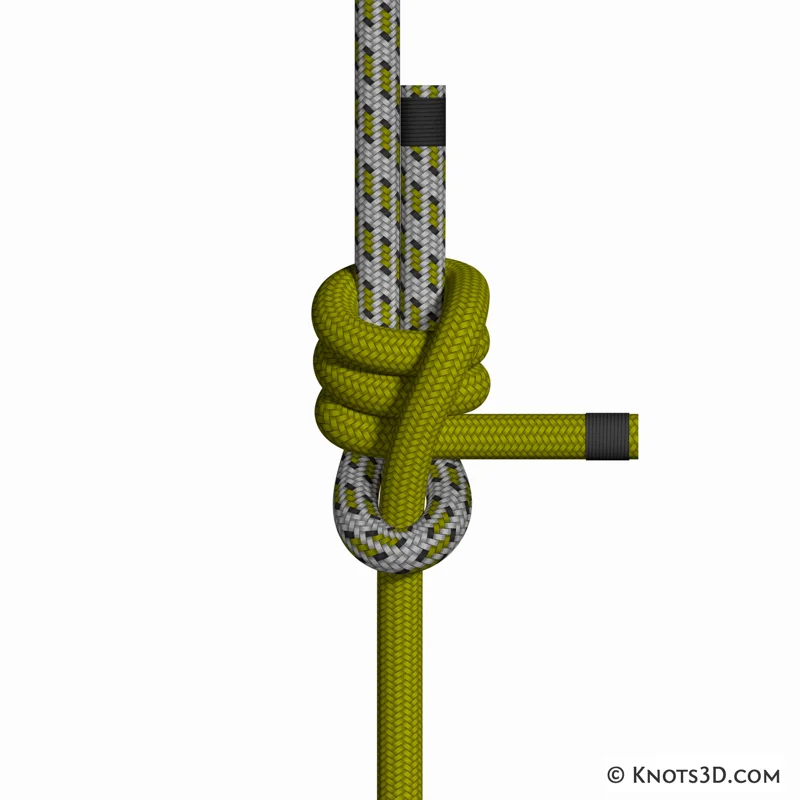


Description
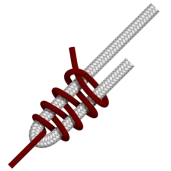
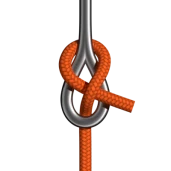
The Triple Sheet Bend, like the Sheet Bend and Double Sheet Bend, is specifically designed for joining a small rope to a much larger one, making it ideal when the size disparity between ropes is considerable. The thicker rope should form a bight (or preferably a seized loop or eye splice) to maximize security, while the smaller line wraps around it three times. It works equally well if the ropes are the same size. The Triple Sheet Bend is often used when working with 'small stuff' — a nautical and knot-tying term for thin string or twine.
History
The Triple Sheet Bend (ABOK #1461) evolved as a practical solution for heavy maritime operations requiring the joining of ropes of vastly different sizes. Clifford W. Ashley documented this knot in The Ashley Book of Knots (1944), noting its regular use in professional seamanship for 'shifting hawsers and cables, in getting them through hawse pipes, and in passing them to shore'. While Ashley provides no specific date of origin or inventor, the knot's specialized maritime applications—particularly its use with hawse pipes and heavy ship's cables—suggest it developed during the age of large sailing vessels and continued into the steam era when handling massive anchor cables and mooring hawsers was routine. Like the Double Sheet Bend, it represents an evolutionary refinement born from practical necessity rather than individual invention, with each additional wrap providing incrementally better security for various rope-joining situations at sea.
Structure
The Triple Sheet Bend is the same basic structure as the standard Sheet Bend but has two extra turns. When correctly tied, the two tails lie on the same side of the knot and is more reliable than if the tails lie on opposite sides.
Strength/Reliability
Adding extra turns to a knot does not always make it more secure and in many cases extra turns weaken a knot. However, in the case of the Triple Sheet Bend, the two extra turns do provide more security, particularly in thin or slippery rope or twine (aka 'small stuff').
Common Uses
- join two ropes of very different thickness with maximum security.
- connect a thin rope to a much thicker one.
- extend a rope by tying it to a much heavier line.
Found in
