Get the app!


Details
TypeBinding
ABOK#1303
Also known as
WoggleNeckerchief SlideTHKBraided RingTurk's Head 3 Lead 5 BightSailor's Knot
Description
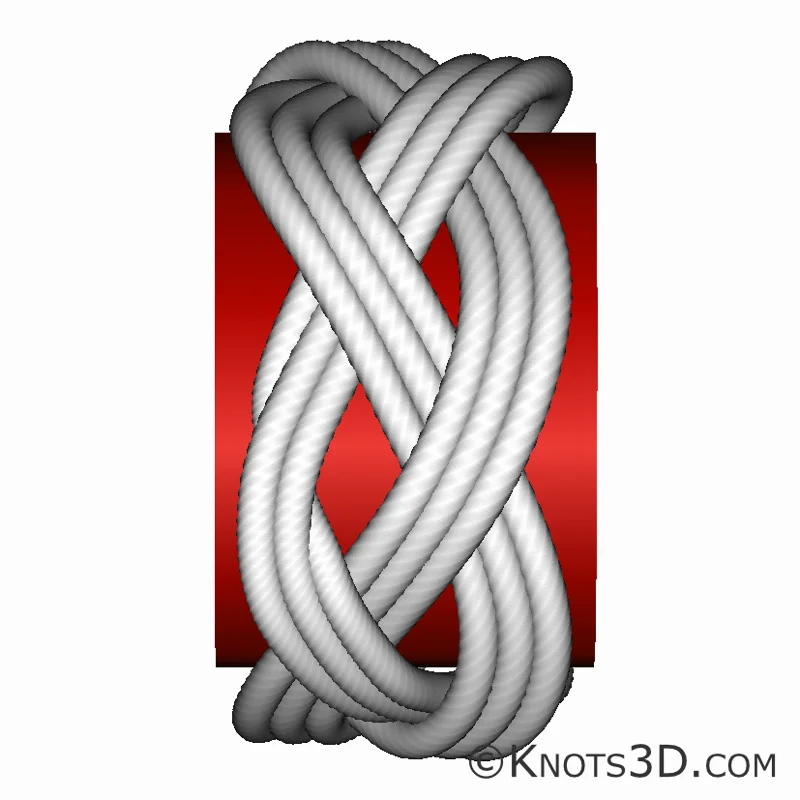
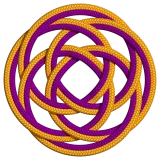
The Turk's Head (Woggle) is a Turk's Head worked in the round, tied around the fingers or directly onto the pole or staff it will grip, so the braid closes into a band rather than a disc. Turk's Heads are continuous braids, and this one has three leads and five bights. Scouts use it as a neckerchief slide, which is where the name Woggle comes from, and the same band serves on a walking stick, a tool handle or a tiller to give a grip that will not slide. The tying follows much the same course as the Single Rope Braid, closed into a ring. Laid out flat instead of worked around a form, the same figure becomes the flat mat.
History
According to Clifford Ashley, the name 'Turk's Head' first appears in published form in Darcy Lever's The Sheet Anchor (1808), but the knot is much older. There is evidence that it was known to the ancient Romans, as it appears in a number of mosaic works of art, and drawings by Leonardo da Vinci in the 15th century show the figure worked flat as a mat. At sea both the mat and the ring form were used extensively. A Turk's Head worked onto the king spoke of a ship's wheel, the spoke that stands upright when the rudder is amidships, let the helmsman find the rudder's center by feel in the dark, and the same knot went onto rails, stanchions and bell pulls for grip and ornament together. The mat form was often called a thump mat and was used to protect and cushion the deck and minimize noise from the pulley blocks hitting it.
Structure
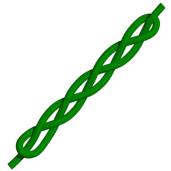
The Turk's Head shown here is of the form 3 Lead, 5 Bight or, in abbreviated notation, 3L5B. A lead is one complete circuit of the cord around the pole, counted before any additional rethreading pass. The 3 in 3L5B therefore means the single line travels around the pole three times, and because those three passes lie side by side the band reads as a three strand braid, the same braid shown in the Single Rope Braid but closed into a ring. The bights are the scallops along each rim of the band where the line turns back, five of them here. Between them the two numbers set the proportions of the ring. Raising the bight count carries the weave further around the circumference, and raising the lead count makes the band wider along the pole.
Note
Tie this form around the fingers or directly onto the pole or staff it will live on, since the ring has to be sized to what it grips. Follow the original lead around a second or third time to double or triple the braid, working the slack right through the circuit on each pass rather than tightening one part at a time. Draw the two ends in under the crossings on the inside of the ring, where they lie hidden against the pole. Worked on a mandrel (tapered spindle) a little larger than the finished ring needs to be, the knot can be slid off and drawn down to fit.
Common Uses
- make a scout neckerchief slide (woggle) from paracord or leather.
- decorate a walking stick, staff, or tool handle with a braided band.
- create a decorative ring or napkin holder from rope or cord.
- add a decorative grip to a tiller, paddle, or fishing rod handle.
- wrap a knife handle with a non-slip braided grip.
- add custom grips to bicycle handlebars.
Found in

