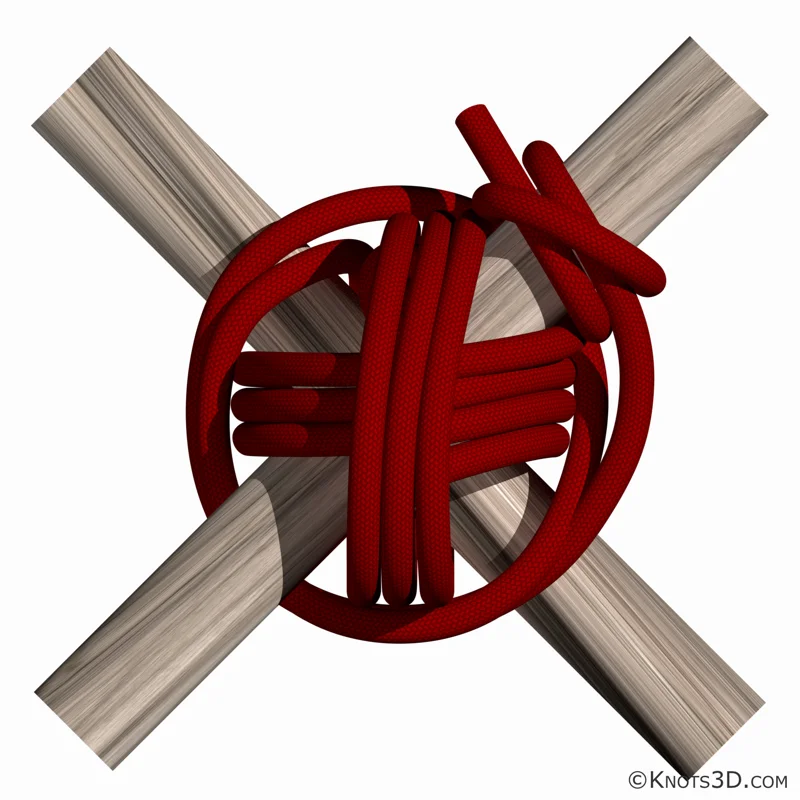


Description
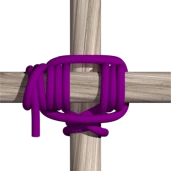
The Diagonal Lashing is a type of lashing used to bind spars or poles together. It is usually applied to cross-bracing where the poles do not initially touch, but may by used on any poles that cross each other at a 45° to 90° angle. Large, semi-permanent structures may be built with a combination of Square Lashing, which is stronger, and Diagonal Lashing. Baling twine has sufficient strength for some lashing applications but rope should be used for joining larger poles and where supporting people sized weights.
Note
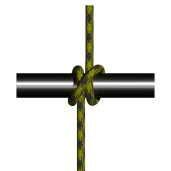
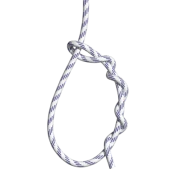
The Diagonal Lashing begins with a Timber Hitch and ends with a Clove Hitch. The initial turns around the poles are called 'wraps'. The final turns around the center, which tighten the lashing, are called 'fraps'. The number of wraps and fraps to use can be recalled with the rhyme: 'Wrap thrice, frap twice'! Lashing strength will be improved if the first turn is 90° to the Timber Hitch and care is taken to lay the rope wraps and fraps in parallel with a minimum of crossing, maintaining maximum contact between the rope and wood.
Common Uses
- bind two poles together at an angle for building camp structures.
- add a diagonal brace to a frame made of poles.
- strengthen a structure by lashing cross-braces between uprights.
- build a simple gate, frame, or trellis from poles.
- construct a tower, bridge, or rigid framework by bracing poles that cross at an angle.
Found in

