Get the app!


Description
The Halter Hitch is a quick-release knot used to temporarily secure a rope to a post, ring, rail, or other fixed object. Its defining feature is the ability to be released instantly with a single pull on the working end, even when the rope is under tension. This makes it useful where rapid release may be necessary. The knot is associated with equestrian use, where it serves as the standard method for tying a horse's lead rope to a hitching rail or post. The quick-release capability is essential for horse safety—if an animal panics and pulls back, a handler can free it immediately with one tug. Beyond equestrian applications, the Halter Hitch is widely used in bushcraft for securing tarps and shelters, in camping for hanging food bags or gear, and in general utility tasks requiring a temporary but secure attachment that can be quickly undone.
History
The Halter Hitch has been used worldwide for generations wherever animals have been tethered. Clifford Ashley documents the knot multiple times (#243, #1804, #1826) in The Ashley Book of Knots, noting that 'horses are hitched with this knot the world over.' Ashley also recounts a personal memory: at age seven, his father gave him a pony on the condition that he master the Halter Hitch—an indication of how fundamental this knot has been to horsemanship.
Structure
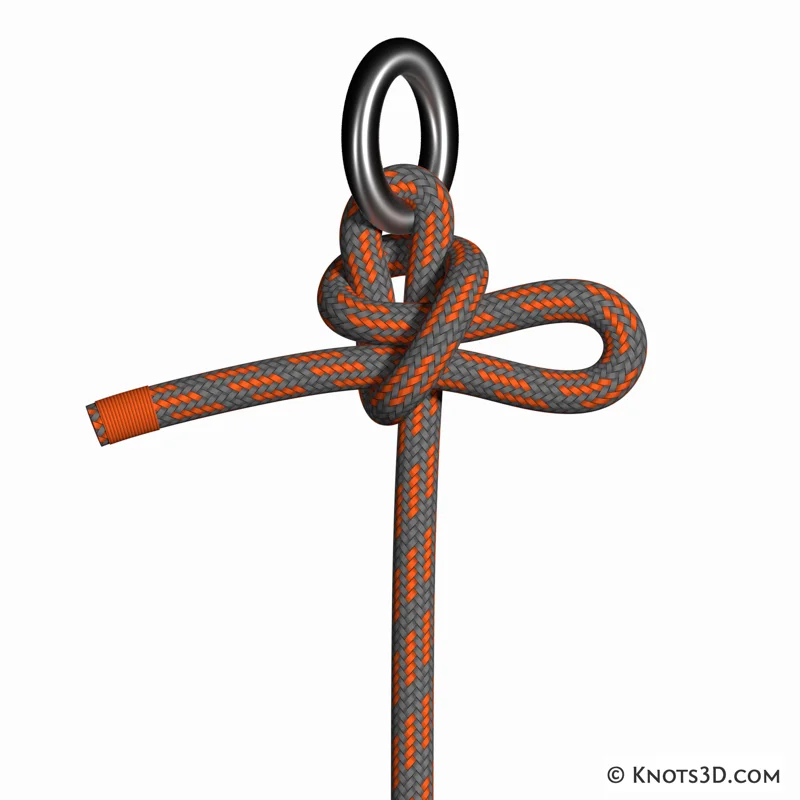
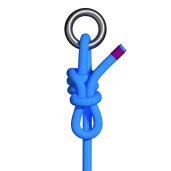
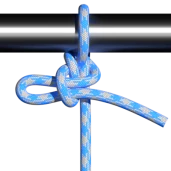
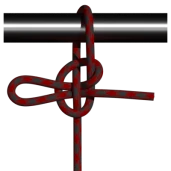
The Halter Hitch is structurally a slipped Overhand Knot (or Noose) tied around the standing part of the rope. The 'slip' is formed by passing a bight of the working end through the knot rather than the end itself, creating the quick-release mechanism. To tie, pass the rope around the anchor object, cross the working end over the standing part, pass it behind both parts, form a bight in the working end, and feed this bight through the loop. Tightening is done by pulling on the standing part.The Halter Hitch is topologically identical to the Falconer's Knot, though falconers tie it one-handed using a specialized technique. The closely related Siberian Hitch adds one additional twist to the slipped bight, effectively creating a slipped Figure Eight around the standing part.
Strength/Reliability
The Halter Hitch provides reliable holding power under steady, moderate loads but has limitations that users should understand. The knot depends on consistent tension to maintain its grip; without a steady load, it may work loose over time. It is also less secure with slick, stiff, or synthetic ropes that don't grip well.For added security, the working end can be passed through the slipped bight. This 'locks' the knot and prevents accidental release (or release by clever animals that learn to pull the free end), while still allowing quick untying by first pulling the end back out of the bight. When tying horses, equestrians often use a safety string made of baling twine tied around the post—if the animal pulls back violently, the twine breaks before injury occurs.The Halter Hitch is not suitable for critical or life-safety applications. For heavier loads or situations requiring greater security, consider the Siberian Hitch or a non-quick-release alternative such as the Round Turn and Two Half Hitches.
Common Uses
- tie a horse to a post or rail with a quick-release knot.
- secure an animal's lead rope so it can be freed in an emergency.
- temporarily tie a boat or small watercraft to a post.
- fasten any rope to a post where quick release is important.
- secure a temporary attachment that can be quickly undone.
- hitch a rope to a post with instant release for securing an animal.
- tie a farm gate shut with a quick-release knot.
Found in
