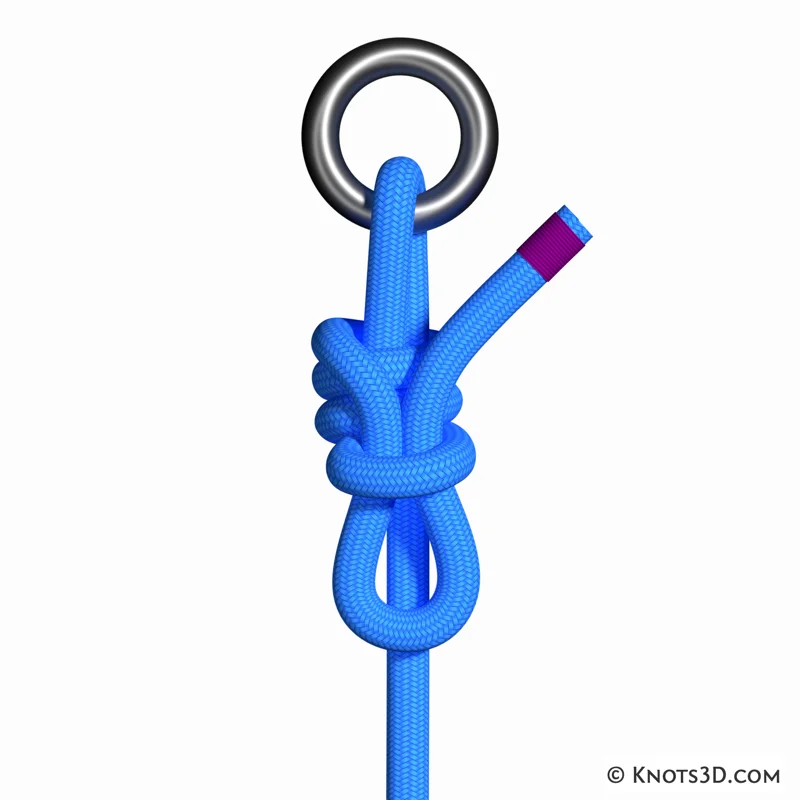


Description
The Manger Hitch is a quick-release hitch used to secure a rope to a ring, rail, or post. Its distinguishing characteristic is that it remains easy to untie even after the rope has become wet—a significant advantage over most other hitches, which tend to jam when soaked. This makes it particularly well suited for tying livestock in environments where ropes are exposed to moisture from rain, condensation, or animal saliva.The knot was traditionally used in dairy farming to secure cows at their stalls, but it serves equally well for general-purpose temporary ties in camping, outdoor work, and other situations where a secure but releasable attachment is needed. While it is a quick-release hitch, the Manger Hitch does not release as instantly as the Halter Hitch; the wrapping turns create a slight delay, and the rope must be pulled back through the ring or anchor point.
History
Clifford Ashley documented the Manger Hitch in The Ashley Book of Knots, noting that he found it in rural Delaware. Ashley explains that the knot was designed to address a practical problem: cows drool constantly, soaking their lead ropes and causing ordinary knots to jam. He writes that 'the cow is an inveterate slobberer' and that while 'not in a class with the camel, she should be made fast with a hitch that will not jam when wet.' Ashley adds with characteristic wit that 'halters in cow barns are about as common nowadays as buttoned shoes in night clubs'—a reflection of changing agricultural practices even by the 1940s.
Structure
To tie the Manger Hitch, pass the rope through the ring or around the anchor object. Bring the working end in front of and then behind both the standing part and the working end itself, creating a wrap around both lines. Make a second wrap in the same manner. Form a bight in the working end and pass it through the loop formed by the wraps, then tighten by pulling on the standing part. The double wrapping turns are what give the knot its jam-resistant properties—friction is distributed across multiple contact points rather than concentrated in a single nip that could bind when wet.
Strength/Reliability
The Manger Hitch is secure and holds well under load, with its primary advantage being resistance to jamming in wet conditions. Most knots become difficult or impossible to untie when the rope absorbs water and the fibers swell, but the Manger Hitch remains workable. This makes it a practical choice for outdoor and agricultural applications where exposure to moisture is expected.The tradeoff for this jam-resistance is a somewhat slower release compared to simpler quick-release hitches like the Halter Hitch. The wrapping turns must unwind, and the rope must be withdrawn from the ring, which takes a moment longer. For situations requiring the fastest possible emergency release—such as freeing a panicked horse—the Halter Hitch may be preferable. The Manger Hitch is better suited to cattle and other applications where a few extra seconds of release time is acceptable in exchange for reliable untying in wet conditions.
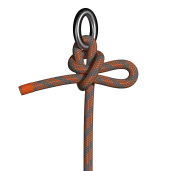
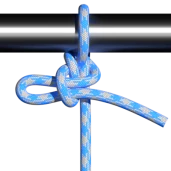
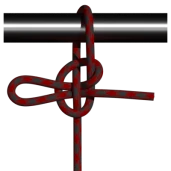
Common Uses
- tie an animal to a post with a quick-release knot.
- temporarily secure a rope to a rail where fast release is needed.
- fasten a line to a ring or post for short-term use.
- secure a rope that must untie easily even when wet from rain or moisture.