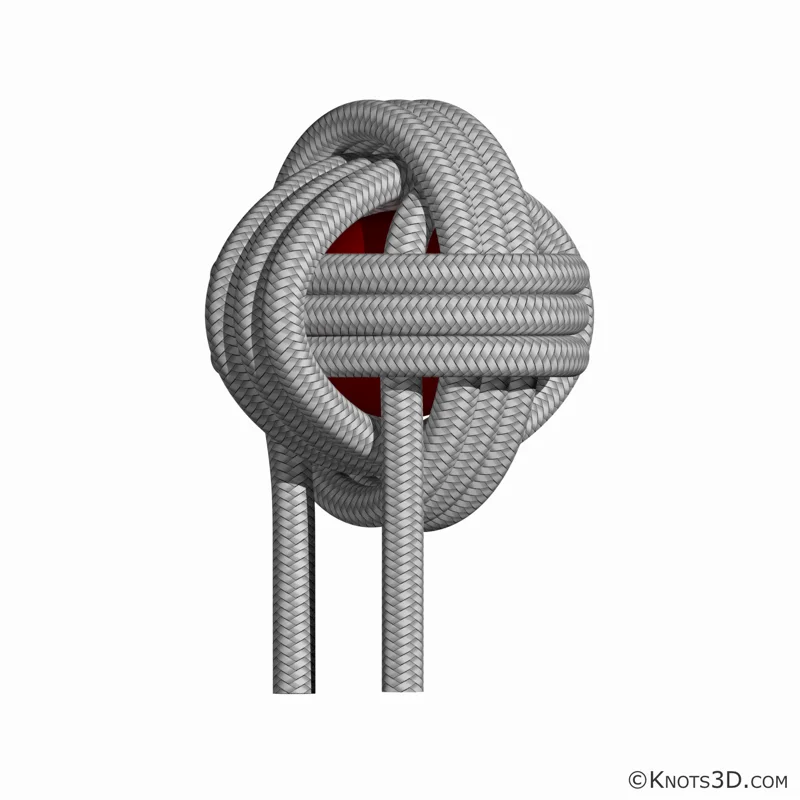


Description
The Monkey's Fist is a decorative and functional knot used to add weight to the end of a rope. Traditionally, it was tied around a stone, piece of metal, or other object to help sailors throw a heaving line between ships or from ship to shore. The knot consists of multiple turns forming a spherical shape, with the weighted core enabling the rope to travel longer distances when thrown. The knot is named for its resemblance to a small, bunched fist or paw. Beyond its nautical use, the Monkey's Fist has found applications in keychains, self-defense tools, and as a decorative knot in crafts.
History
In addition to its nautical use, the Monkey's Fist, tied around a rock or other heavy ball-shaped object, was historically used as an improvised melee weapon, known as a slungshot, by sailors in the 19th century. Due to its effectiveness as a weapon, slungshots were outlawed in many U.S. states, including California, Oklahoma, and Michigan. The first known mention of the Monkey's Fist appears in the 1888 illustrated nautical book 'Log Book Notes Through Life' by American writer Elizabeth N. Little.
Structure
The Monkey's Fist is a symmetrical knot and is often tied around a small weight, such as a stone, marble, tight fold of paper, or a piece of wood. Ashley describes four different ways to tie this knot, resulting in the same structure.
Common Uses
- add weight to a rope end so it can be thrown over a distance.
- create a decorative ball knot for a keychain or zipper pull.
- make a weighted knot for crafts, curtain pulls, or drawer handles.
- toss a line over a tree branch for hanging a bear bag or swing.
- wrap around a tennis ball to make a durable rope dog toy.
- make a decorative curtain tieback or pull.
- make a weighted self-defense tool (slungshot) on a lanyard.
- weight a rescue throw rope for swiftwater or river rescue.
- make oversized decorative rope orbs from sisal rope for nautical-themed home décor.
- throw a light line from a boat to shore or between vessels.
- wrap a rock inside the knot to weight a bear bag throwing line.
Found in
