

Description
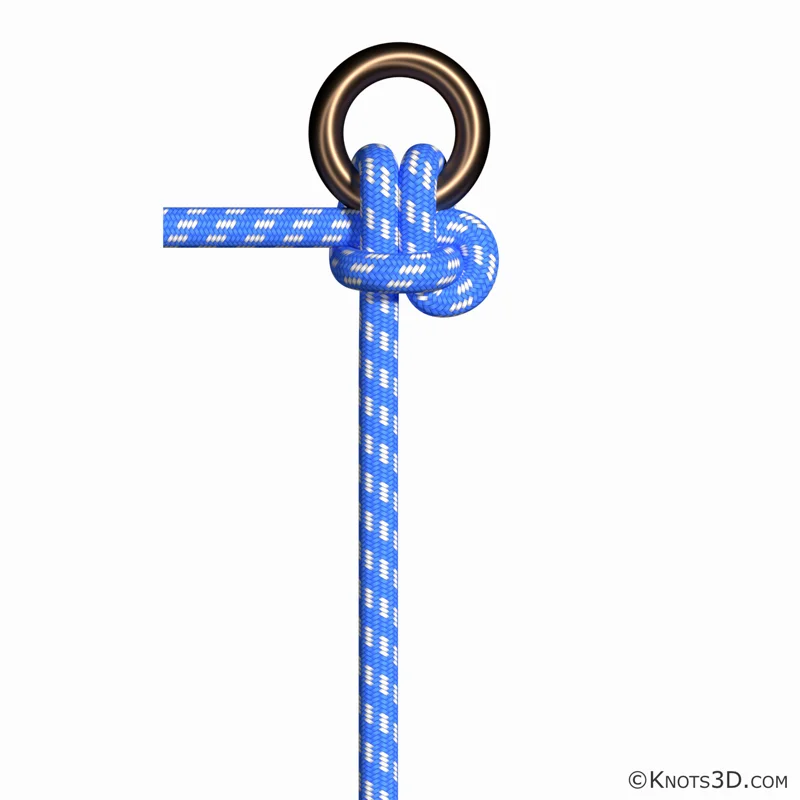
The Pedigree Cow Hitch is a more secure variation of the standard Cow Hitch, also known as the Lark's Head. It can be used for many of the same applications, such as attaching a rope to a ring, pole, or spar. However, it is preferred for critical applications when security is important, such as with climbing, sailing, and rescue operations.
History
Given its name by Dr. Harry Asher, the Pedigree Cow Hitch appears in the Alternative Knot Book published in 1989. Harry Asher was a British physicist and a renowned knot enthusiast who made significant contributions to the field of knot tying. He is perhaps best known for his work in formalizing and popularizing various knots, including the Pedigree Cow Hitch. The term 'Pedigree' in the name suggests that this knot is a refined or 'improved' version of the standard Cow Hitch, reflecting Dr. Asher's attempt to create a more reliable and secure knot.
Structure
The Pedigree Cow Hitch has the same form as the simple Cow Hitch except that one of the strands is tucked back through the hitch.
Strength/Reliability
The original Cow Hitch is a simple knot used to attach a rope to an object. However, it is known for being somewhat insecure under certain circumstances, particularly when both strands are not under constant tension. The Pedigree version adds a tucked half hitch to the non-loaded end of the rope which improves its security and reliability. To quote Asher, 'One extra tuck transforms this least secure of all hitches into one of the most secure.'
Warning
Verify tying technique with a skilled instructor where knot failure could cause property damage, injury, or death.
Related
Common Uses
- attach a rope to a ring or post more securely than a basic cow hitch.
- hang an item from a hook or rail where extra grip is needed.
- fasten a lanyard or cord to a ring with added security.
- connect a rope to a fixed loop or eye where slipping must be avoided.
Found in


