

Description
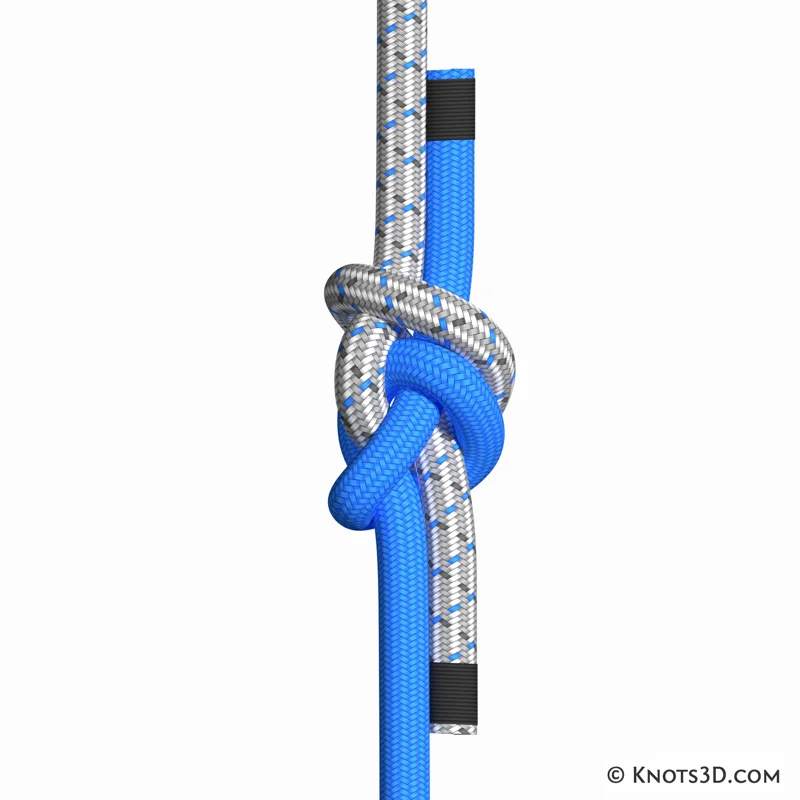
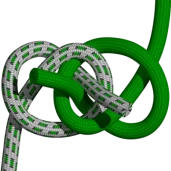
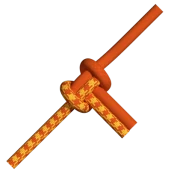
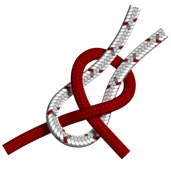
The Shake Hands Bend is a secure and symmetrical bend knot used for joining two ropes of similar diameter. It consists of two interlocking overhand knots, with each rope forming a simple overhand around the standing part of the other. This interlocking structure is similar in principle to other highly regarded bends such as the Zeppelin Bend, Hunter's Bend, and Alpine Butterfly Bend, all of which belong to the family of interlocking overhand knots. What distinguishes the Shake Hands Bend from its relatives is its unique configuration: the working ends emerge parallel to the opposite standing ends, creating a streamlined, low-profile bend. This parallel arrangement makes it particularly useful in applications where the joined ropes must pass through rings, pulleys, or other narrow openings. Once learned, the Shake Hands Bend is relatively easy to tie and inspect, and it typically unties without difficulty after being loaded.
History
The Shake Hands Bend does not appear in The Ashley Book of Knots (first published in 1944), though a related structure—the Shake Hands Loop—is documented as both #1031 (tied with an end) and #1048 (tied in a bight). The bend variation gained prominence when it was featured in Dr. Harry Asher's 'The Alternative Knot Book' (1989), where Asher highlighted it as one of the better bend knots and introduced his systematic notation for classifying interlocking overhand knot bends. Asher noted the knot's distinctive feature: the working ends emerging parallel to the opposite standing ends, which distinguishes it from other members of the interlocking overhand family such as the Zeppelin Bend and Hunter's Bend.
The name 'Shake Hands Bend' likely derives from the visual appearance of the two ropes grasping each other in a manner reminiscent of a handshake. Unlike some knots with documented maritime or climbing lineage, the Shake Hands Bend does not have a well-recorded history of traditional use in specific trades or vocations. Its recognition in modern knot literature stems primarily from systematic studies of knot topology and the exploration of interlocking overhand knot variations by knot theorists and researchers in the late 20th century.
Structure
The Shake Hands Bend is constructed from two interlocking overhand knots arranged side by side with partial overlap. Each rope forms an overhand knot that links with the other, creating a symmetrical structure. The defining structural characteristic is that each working end exits the knot alongside—and parallel to—the opposite rope's standing part. This parallel orientation of ends to standing parts is relatively unique among interlocking overhand bends and gives the knot its distinctive appearance and low profile. The two overhand knots in the Shake Hands Bend sit beside each other rather than being fully nested or stacked, which differentiates it from similar bends like the Hunter's Bend or Zeppelin Bend. This side-by-side arrangement, combined with the parallel exit of the working ends, allows the knot to be seized or taped for an even more streamlined connection. The knot can be tied either by forming each overhand knot sequentially and threading the second rope through the first, or by using a follow-through method similar to tying a loop. When properly dressed, the knot displays clear symmetry, making it relatively easy to visually verify correct tying
Strength/Reliability
The Shake Hands Bend is considered a strong and secure bend when tied correctly in ropes of similar diameter. As a member of the interlocking overhand knot family, it shares the general reliability characteristics of related bends like the Zeppelin Bend and Alpine Butterfly Bend. The knot provides good holding power under load and is less prone to jamming than some other bend knots, which means it can typically be untied with reasonable ease even after bearing significant tension. However, the Shake Hands Bend is somewhat more application-specific than other interlocking overhand bends. While it performs well in situations requiring a streamlined profile—such as when the joined ropes need to pass through hardware or tight spaces—it may not be the first choice for maximum strength under extremely heavy or shock loads. The knot's security depends on proper dressing and adequate tail length, as with all bends. The parallel arrangement of working ends alongside standing parts makes it particularly suitable for seizing or taping the tails to the standing parts, which further reduces the knot's profile and can enhance security. The knot performs adequately in various rope types, though proper inspection before and after use is always recommended to ensure the structure remains correctly formed.
Warning
Verify tying technique with a skilled instructor where knot failure could cause property damage, injury, or death.
Common Uses
- join two ropes with a compact knot that won't jam after heavy loading.
- connect two ropes where easy untying is needed later.
- tie two ropes of similar thickness into one longer line.
Found in
