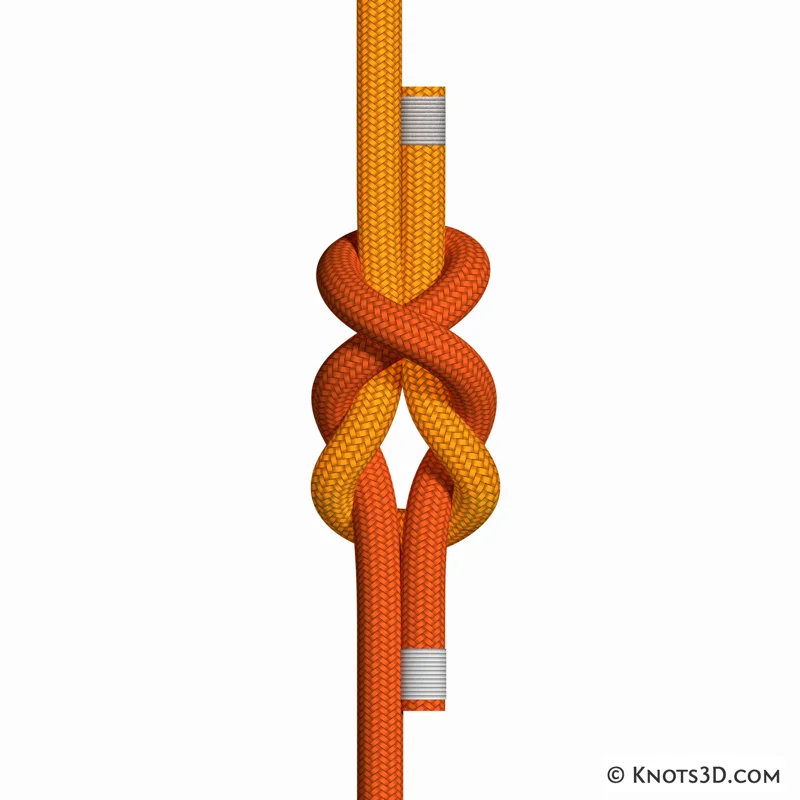


Description
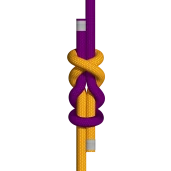
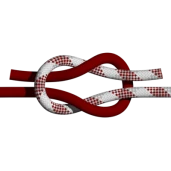
The Simple Simon Over is a bend used to join two ropes together, particularly when working with modern synthetic cordage that can be slippery and difficult to secure with traditional bends like the Sheet Bend. It can also be used to join ropes of different diameters, with the thinner rope typically forming the working end that wraps around the bight of the thicker rope. This is the simplest and least secure member of the Simple Simon family of bends. For applications requiring greater security, the Simple Simon Under, Double Simon Over, or Double Simon Under should be considered.
History
The Simple Simon bends were invented by Dr. Harry Asher, a retired research scientist and prominent member of the International Guild of Knot Tyers. They were published in his 1989 book The Alternative Knot Book. Asher developed the Simple Simon knots as an improvement on the Sheet Bend, seeking a bend that would be more secure with slippery synthetic ropes while remaining simple to tie. Asher described his approach: 'When I had decided that the way to try for new bends was to think of the two halves separately, and then decide how to put them together. There seemed to be no better way than to start with the two halves that make up the famous Sheet Bend... an open loop and a single hitch.' The Simple Simon family includes four main variants of increasing security: Simple Simon Over, Simple Simon Under, Double Simon Over, and Double Simon Under. Dick Clements later developed the Symmetric Simple Simon (SSS), published in Knotting Matters in 2006.
Structure
The Simple Simon Over begins like a Sheet Bend: form a bight in one rope, then pass the working end of the second rope up through the bight, around both legs of the bight, and back through the bight parallel to where it entered. The key distinction is that as the working end crosses back over itself to complete the knot, it passes OVER its own standing part—hence the name 'Over.'As with the Sheet Bend, the two running ends should emerge on the same side of the knot for proper function.
Strength/Reliability
The Simple Simon Over is more secure than a standard Sheet Bend, particularly with slippery synthetic ropes, but it is the least secure of the four Simple Simon variants. The 'Over' configuration provides less friction than the 'Under' version because the working end does not lock against its own standing part as effectively. For critical applications or very slippery cordage, the Simple Simon Under or one of the Double Simon variants is recommended. The Simple Simon Over is suitable for moderate loads and temporary joins where ease of tying is prioritized over maximum security.
Warning
Verify tying technique with a skilled instructor where knot failure could cause property damage, injury, or death.

Common Uses
- join two ropes of similar or slightly different thickness.
- connect two ropes with a simple, compact bend.
- securely connect slippery, synthetic rope.
Found in
