

Description
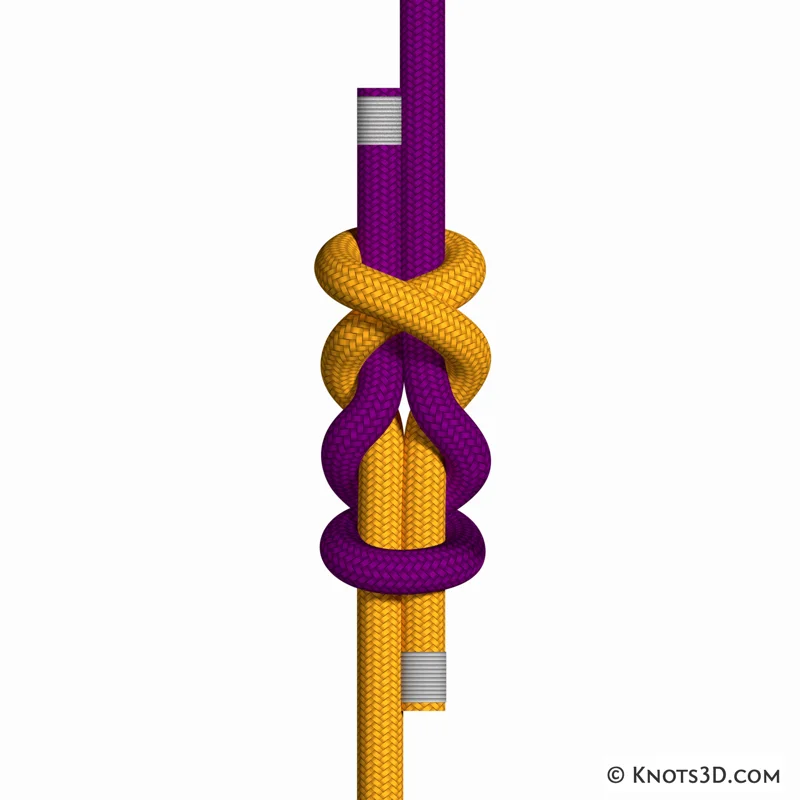
The Symmetric Simple Simon is a bend used to join two ropes of similar or different diameters. It excels with modern synthetic cordage (nylon, polyester) that is difficult to secure with traditional bends. The knot is suitable for applications requiring high security: rigging, climbing, rescue work, and any situation where a bend must absolutely not slip, loosen, or spill under dynamic loading. Unlike some bends, it remains stable even if tied incorrectly—mixing Over and Under variants still produces a secure knot. Its main limitation is the difficulty in untying after heavy loading.
History
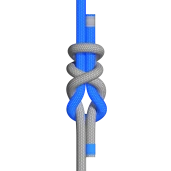
Developed by Dick Clements and published in Knotting Matters Issue 92 (September 2006). The Symmetric Simple Simon evolved from Harry Asher's original Simple Simon family (Simple Simon Over, Simple Simon Under, and Double variants introduced in The Alternative Knot Book, 1989). Clements extended Asher's work by creating four symmetric variations based on different axes of symmetry. Through empirical testing with both 4mm braided nylon and 15mm 3-strand twisted terylene rope, Clements identified the specific variation shown in the animation above as the optimum version, offering the best balance of ease of tying, ease of working tight, security, compactness, and fault tolerance. Clements notes that this is the first published version of a symmetric Simple Simon bend.
Structure
The Symmetric Simple Simon consists of two ropes, each wrapping around the paired standing part and working end of the other rope. When the paired standing parts are pulled firmly, the bend tightens into a compact form with the working ends naturally lying adjacent to the standing parts. There are two primary variants of the Symmetric Simple Simon: Over/Over and Under/Under. Additionally each of these variants can be tied with the working end exiting with both ends on the same side or on opposite sides. The Symmetric Simple Simon shown in the animation is composed of two 'Over' variants of the Simple Simon family with working ends exiting on opposite sides. Clements identified this as the optimal version based on the attributes of a good knot (easy to tie, easy to work tight, very secure, compact, and forgiving of tying errors).
Strength/Reliability
The Symmetric Simple Simon is empirically proven to be more secure than any variant of the plain Simple Simon family (Over, Under, or Double variants). Through extended experimentation with both stiff and slippery cordage, Clements found it significantly more resistant to loosening, unravelling, slipping, capsizing, and spilling when subject to intermittent or jerking loads. The knot's symmetrical construction provides redundancy—importantly, if one variant is tied in error (mixing Over and Under elements), both derivatives remain stable and secure, making it extremely fault-tolerant. Against these significant advantages must be weighed the disadvantage that the bend is quite difficult to untie after heavy loading. It is not particularly elegant or beautiful by appearance, though this is subjective and irrelevant for most practical applications where security is paramount.
Warning
Verify tying technique with a skilled instructor where knot failure could cause property damage, injury, or death.
Common Uses
- securely join two slippery synthetic ropes.
- connect two ropes of different materials under changing loads.