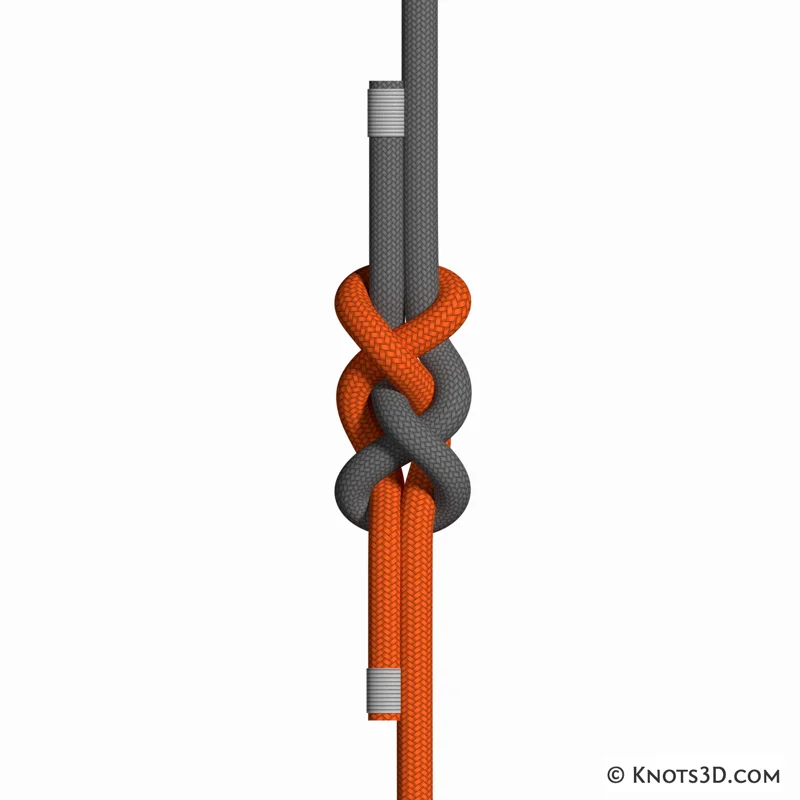


Description
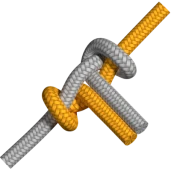
The Vice Versa is a secure bend used for joining slippery synthetic ropes that would fail with traditional bends like the Sheet Bend. One of its most distinctive applications is joining shock cord (bungee or elastic cord), where most other bends slip or fail due to the material's elasticity and smooth surface. The knot's double-clamping structure resists loosening under intermittent or variable loads, making it suitable for applications where the load cycles on and off repeatedly. It can join ropes of similar or different diameters.
History
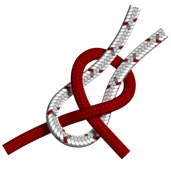
The Vice Versa Bend was developed by Dr. Harry Asher and published in his 1989 book The Alternative Knot Book, where he noted it as a 'new' knot. Asher presented it as part of a developmental sequence alongside the Simple Simon Over and Simple Simon Under, all inspired by aspects of the Sheet Bend. The knot later appeared in Roger E. Miles' 1995 book Symmetric Bends, where Miles classified it as a 'pure lanyard bend' and attributed it to Asher. In 2004, Dick Clements published an analysis titled 'The Vice Versa Bend and the Reever Knot' in Knotting Matters Issue 85, revealing that the Vice Versa is structurally identical to the Reever Knot (first published by C.E.I. Wright and J.E. Magowan in the Alpine Journal, 1928). The only difference is the selection of standing ends: the Vice Versa has standing ends emerging from the same side, while the Reever Knot is fully symmetric with standing ends on opposite sides. Clements' analysis suggested the Reever form may be superior due to its complete symmetry, though both versions are secure and reliable.
Structure
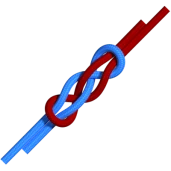
Structurally, the Vice Versa Bend is identical to the Reever Knot, except that the Vice Versa has working ends emerge on the same side while the Reever Knot has working ends that exit on opposite sides.
Strength/Reliability
The key feature of the Vice Versa Bend is that each line is clamped at two points within the knot, providing extra security. This makes it resistant to loosening, even under intermittent, cyclical or variable loads. It performs reliably with slippery synthetic materials and in shock cord where many traditional bends fail. Its main weakness is difficulty untying after heavy loading, especially in smaller cordage.
Warning
Verify tying technique with a skilled instructor where knot failure could cause property damage, injury, or death.
Common Uses
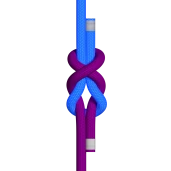
- join two slippery synthetic ropes securely.
- connect two elastic cords (bungee cord) together.
- tie two ropes of similar size where other bends tend to slip.