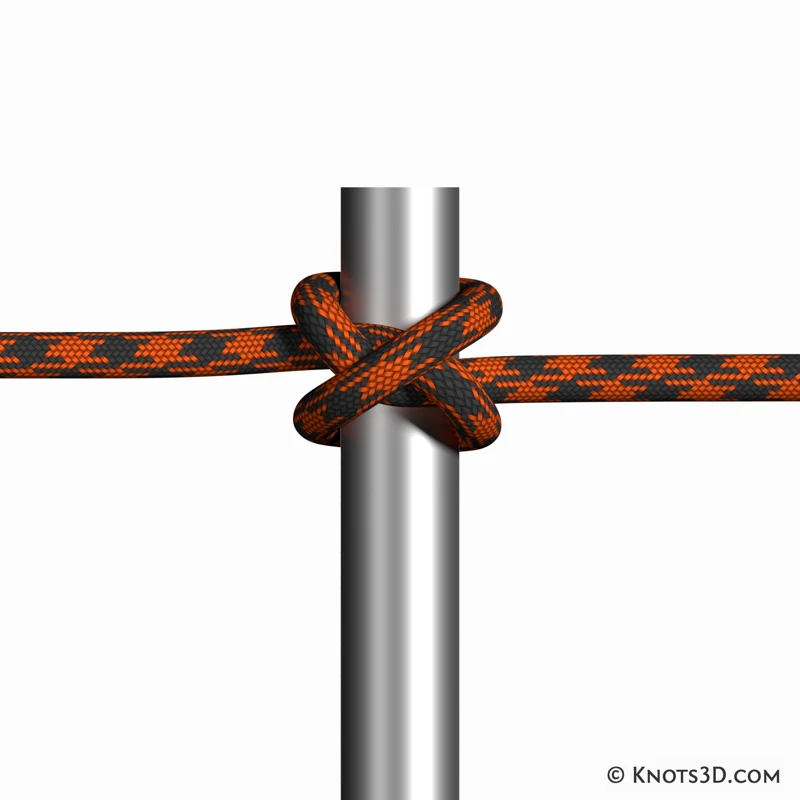


Description
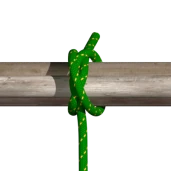
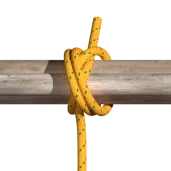
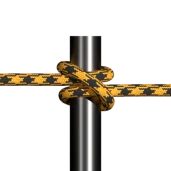
The Constrictor in the Bight is the Constrictor Knot formed in the middle of a rope and then dropped over the end of the object it is to bind. Because it is made without the working end, it can be tied more quickly than passing an end around a post several times. The method needs a free end on the object rather than on the rope, so it suits posts, rails, pipes and dowels but not a spar attached at both ends. Once seated and drawn tight it grips as hard as the knot tied any other way. It is difficult and often impossible to untie, so it is usually cut off.
Structure
The finished knot is identical to the Constrictor Knot and differs only in how it is formed. Two loops are made in the standing part and folded across one another so that the crossing falls where the riding turn belongs. Dropping the paired loops over the end of the object and drawing the two standing parts apart seats the overhand knot beneath the riding turn.
Strength/Reliability
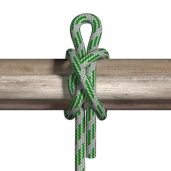
Binding force and security match the Constrictor Knot, and so does the drawback. Once drawn up hard the knot is difficult and often impossible to untie, so it is usually cut off. Where the binding has to be released again, the Slipped Constrictor Knot is tied with a draw loop instead. A second riding turn, as in the Double Constrictor, holds better on hard or slippery surfaces.
Common Uses
- bind a post or rail without needing access to either end of the rope.
- slip a finished binding over the end of a pipe or dowel.
- bind a bundle of poles by dropping the knot over one end.
Found in

