
Rope mats turn a length of line into something flat, sturdy and useful, and several of them began as working gear aboard ship. A mat is a closed, interlaced weave, usually tied in a single line that is then followed around the pattern again, often more than once, so the face fills in and lies flat. Sailors laid mats wherever a rope ran over a wooden edge or a block could strike the deck, so the mat took the wear instead of the timber. The same patterns now make coasters, trivets, table mats, doormats and stair treads, and the size depends on the pattern, the number of rounds and the thickness of the line. This list covers the essential mats. The Carrick Mat suits small work such as coasters and badges, and the Ocean Plait is one of the two most common rope mats. The Turk's Head Mat (3L5B) and Turk's Head Mat (5L4B) show a Turk's Head opened out flat, and the Celtic Knot is a rectangular pattern that can be built up into a woven mat.
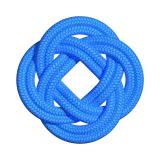 Carrick Mat
A decorative flat mat based on the Carrick Bend.
Carrick Mat
A decorative flat mat based on the Carrick Bend.
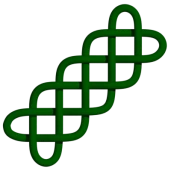 Celtic Knot
Decorative interwoven rectangular mat.
Celtic Knot
Decorative interwoven rectangular mat.
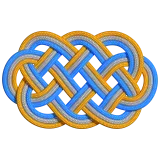 Ocean Plait
Decorative oval mat woven from a single line.
Ocean Plait
Decorative oval mat woven from a single line.
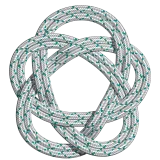 Turk's Head Mat (3L5B)
Decorative braided mat.
Turk's Head Mat (3L5B)
Decorative braided mat.
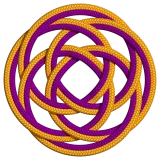 Turk's Head Mat (5L4B)
Decorative round mat.
Turk's Head Mat (5L4B)
Decorative round mat.
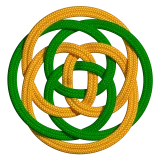 Turk's Head Mat (6L4B)
Decorative flat mat woven from two separate cords.
Turk's Head Mat (6L4B)
Decorative flat mat woven from two separate cords.
Warning