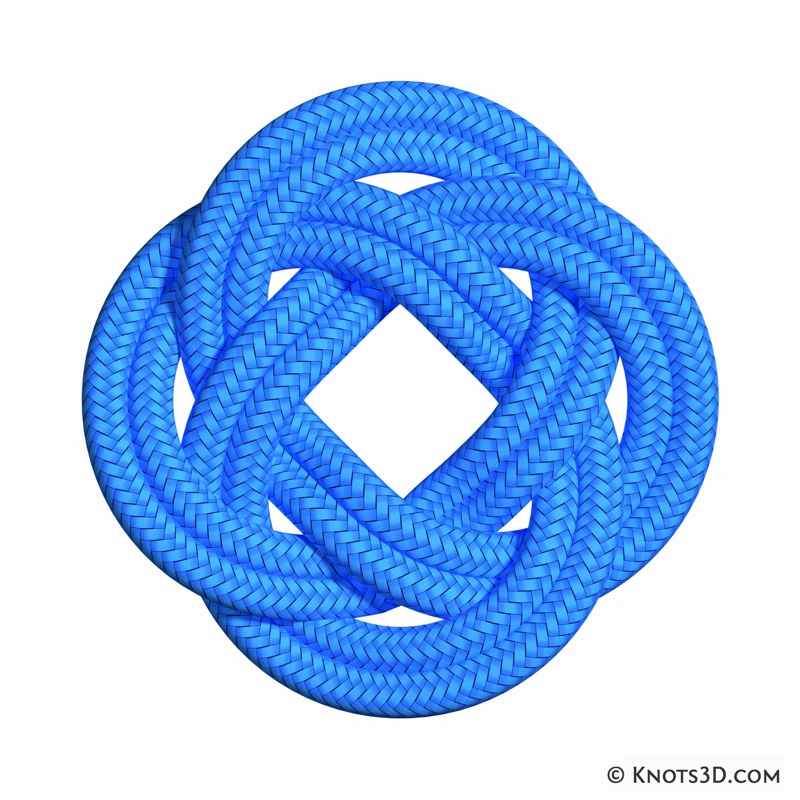


Description
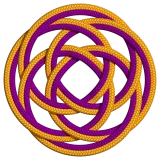
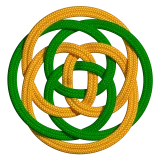
The Carrick Mat is the flat, closed form of the Carrick Bend. Where the bend joins two separate ropes, the mat is worked in a single line whose ends are brought together so the figure runs continuously, and the line is then followed around a second time so the finished mat is doubled throughout. The result is a round disc that lies flat and stays put. It suits small work best. Tied in four millimetre line and followed round four times it makes a drink's mat, and in fine line it is small enough to wear as a badge. Worked in heavy rope it becomes cumbersome, and other mats serve better at that size. Tied around the hand rather than laid out flat, the same pattern closes into a ring that serves as a neckerchief slide. Cord with some lengthwise stiffness holds the weave best, since limp rope lets the pattern slump and the mat loses its shape.
History
Ashley cataloged this mat as #2287 but gave it no name, describing it only as a three lead, four bight (3L4B) Turk's Head in disk form. He records that the same figure is the Pretzel Knot of the braid trade, and that closing the ends of that knot produces this one. The mat is the logo of the International Guild of Knot Tyers, where it is read as the four points of the compass all joined together in a knot, and many members tie it in fine line to make their own badge.
Structure
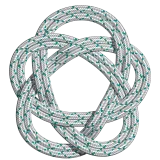
The Carrick Mat is a Turk's Head of the form 3 Lead, 4 Bight, or 3L4B in abbreviated notation, laid out flat rather than tied around a pole. A lead is one complete circuit of the cord around the knot, which in a flat mat means one journey around the hole at the center, counted before any doubling pass. The 3 in 3L4B therefore means the single line travels around three times, and because those three passes lie side by side the weave reads as a three strand braid even though only one line is used. The bights are the scallops around the outside edge where the line turns back, four of them here. Following the lead around a second time doubles every part of the weave, which is what gives the mat its closed, solid face rather than the open lattice of a single pass. The Carrick Mat is also a continuation of the Double Coin Knot (Josephine Knot) with the ends forming a fourth loop.
Note
Bring the two ends together alongside each other and follow the original lead around a second time, or a third, to double or triple the whole mat. The ends should not be left at the rim. Draw them into the center of the weave and sew or seize them on the underside so the edge stays unbroken. A coaster or table mat can be stiffened with an acrylic or PVA glue or a varnish, though it is worth testing how the coating reacts with the material first. Clear sealant smeared over the back holds the layers in place and adds grip, but it makes the mat one sided.
Common Uses
- make a table mat or hot pad from cord or light rope.
- protect a deck or rail where a rope rubs against it.
- form a coaster or a small woven panel for craft work.
- tie a badge or lapel piece from fine line.
- make a neckerchief ring by tying it around the hand instead of flat.
Found in
