Get the app!


Description
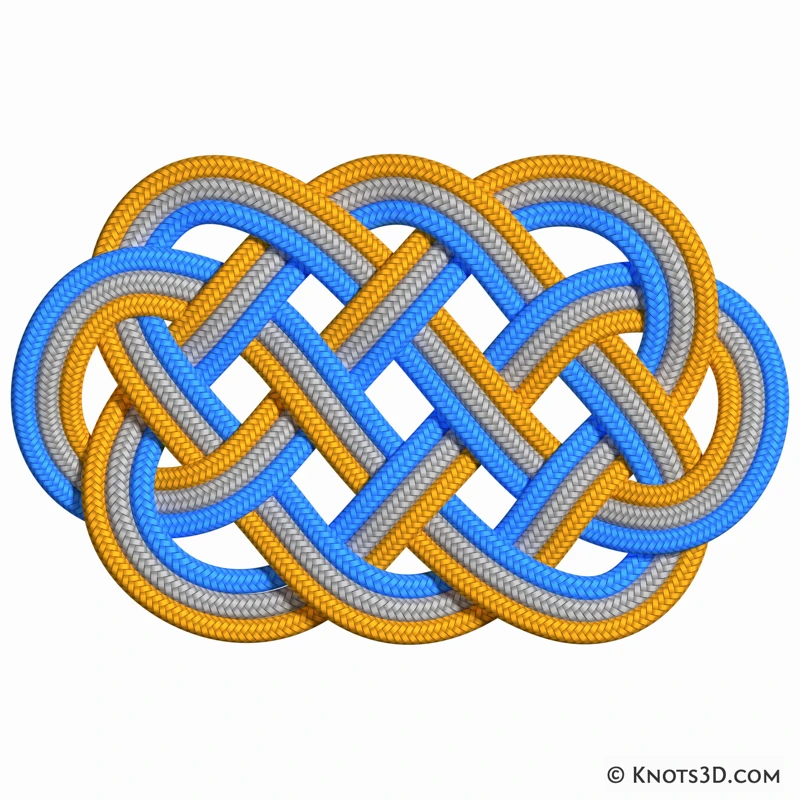
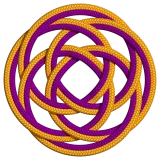
The Ocean Plait is a flat oval mat woven from one line although multiple colored lines can also be used to give the mat more character. Small versions in fine cord serve as table mats and coasters, while larger ones in heavier rope make doormats and treads that give firm footing on a wet step. It is one of the two most common rope mats and one of the easier ones to make. Aboard ship, mats of this kind were laid wherever a rope ran across a wooden edge so that the mat took the wear instead of the timber, and worn out sheets and halyards were often worked up into doormats rather than thrown away. Size is governed by three things, which are the number of parts in the knot, the number of rounds the line is followed through, and the thickness of the rope itself.
History
Ashley cataloged the mat as #2243 and spelled it Ocean Plat, recording that he took the name from a specimen in the South Kensington Museum collection rather than coining it himself. He notes that the mat is identical in construction to the Chinese, or flat, knife lanyard knot, and differs only in how the ends are disposed. Mats of this family were made aboard sailing ships during long calms, when there was time to work old rope into something that would protect the deck from chafe.
Structure
The Ocean Plait is not a Turk's Head and carries no lead and bight designation. It belongs instead to a family of symmetrical mats woven from the ends of a single line, and it is described by the number of bights along each side.
Note
The mat uses far more line than its finished size suggests. A large mat may take four times the length of the finished piece, so measure generously and keep a note of how much went into a given mat for the next one. Thicker rope will not hold its shape while being worked and is best pinned out on a board until the last tuck is made. Follow the line round to double or triple the mat, and up to six times round if a denser face is wanted. Two rounds look plain and may not sit flat, six sit flat but look busy, and three is the usual compromise. Finish by drawing both ends into the middle of the weave and sewing or seizing them underneath rather than leaving them at the rim. A finished mat that turns out too small can be enlarged by coiling rope around the outside and sewing the turns together.
Common Uses
- make a table mat, coaster or hot pad from fine cord.
- weave a doormat or a stair tread from heavier rope.
- protect a deck where a rope runs over a wooden edge.
- work worn out sheets or halyards up into something useful.
- give sure footing where a smooth deck or a stair tread gets slippery.
Found in
