Get the app!


Details
TypeMats
ABOK#1306
Also known as
Turk's Head 3 Lead 5 BightTHKTurk's Head in the FlatSailor's Knot
Description
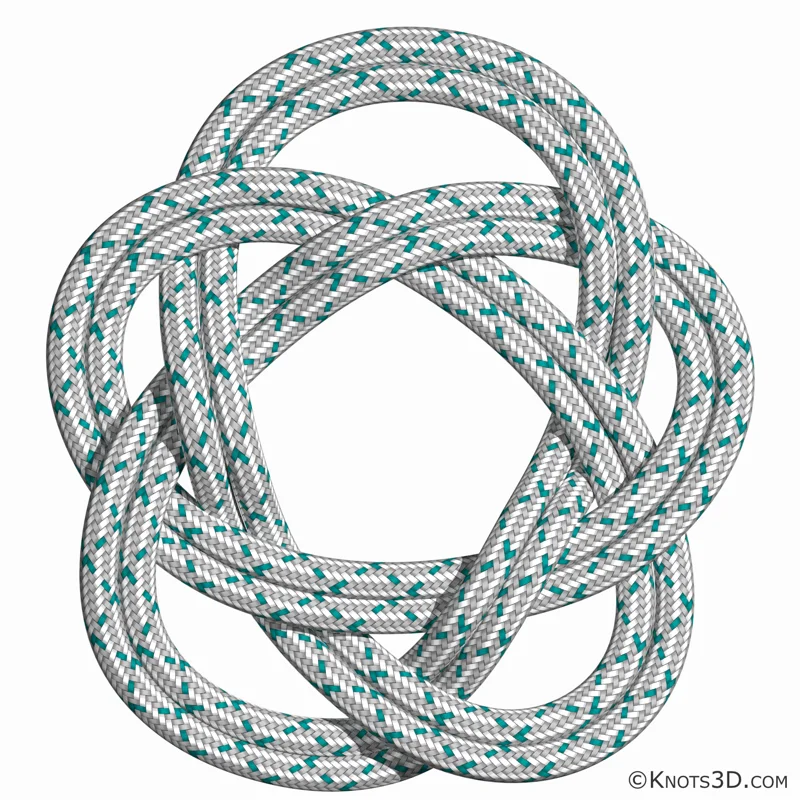
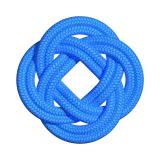
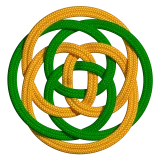
The Turk's Head Mat (3L5B) is a Turk's Head worked flat instead of around a pole, so the braid closes into a disc that lies flat and stays put. Turk's Heads are continuous braids, and this one has three leads and five bights. Following the lead around a second or third time doubles or triples the weave and gives the mat a solid face rather than an open lattice. Worked in fine cord it makes a coaster or a trivet, and in heavier rope a doormat or a pad that takes the wear where a line runs over an edge. The same figure tied around the hand or onto a pole rather than laid out flat becomes the ring form.
History
According to Clifford Ashley, the name 'Turk's Head' first appears in published form in Darcy Lever's The Sheet Anchor (1808), but the knot is much older. In fact, drawings by Leonardo da Vinci in the 15th century show a number of Turk's Head knots in mat form, similar to the one shown here. There is evidence that the knot was known by the ancient Romans, as it appears in a number of mosaic works of art. Laid flat on deck the mat had a working name of its own, the thump mat. Des Pawson, in Knot Craft and Rope Mats, describes putting one over the eyebolt that a deck mounted block is shackled to, so the block comes down on a cushion rather than on the planking each time the rope running through it slackens, which deadens the noise and saves the deck from chafe. He credits Hervey Garrett Smith's The Marlinspike Sailor as where he first saw the mat used that way.
Structure
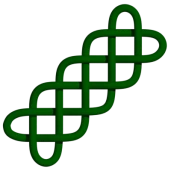
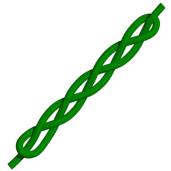
The Turk's Head shown here is of the form 3 Lead, 5 Bight or, in abbreviated notation, 3L5B. A lead is one complete circuit of the cord around the knot, which in a mat means one journey around the hole at the center, counted before any additional rethreading pass. The 3 in 3L5B therefore means the single line travels around three times, and because those three passes lie side by side the weave reads as a three strand braid, essentially the common 3 strand braid of the Single Rope Braid closed on itself. The bights are the scallops around the rim where the line turns back, five of them here. A Turk's Head can be tied in a single line only when its lead and bight counts share no common factor, which 3 and 5 do not, and that is why a mat with three apparent strands needs only one cord. Adding leads and bights gives larger and more intricate mats, and the Turk's Head Mat (5L4B) is the next step up.
Note
The method shown here is the one used for a flat Turk's Head mat. Follow the original lead around a second or third time to double or triple the braid, which closes the gaps between the parts and gives the mat a solid face. Work the slack out evenly all the way round rather than drawing any one part up tight, or the figure will run out of shape. Draw both ends into the body of the mat and sew or seize them on the underside so the rim stays unbroken. The same 3L5B figure can be worked in the round instead, though it is tied differently, around the fingers or straight onto the pole.
Common Uses
- weave a flat decorative mat for a table, floor, or doorstep.
- make an ornamental coaster or trivet from rope or cord.
- create a traditional maritime decoration for a boat or home.
- craft a circular rope mat for display or practical use.
- serve as a centerpiece on a decorative knot board.
- add a decorative accent to a curtain tieback.
- make a decorative knot for a gift or craft project.
- make a thump mat to protect the deck where a block would strike it.
Found in
