Get the app!


Details
TypeMats
Also known as
Turk's Head 6 Lead 4 BightTwo-Strand Turk's Head MatTurk's Head in the FlatTHK
Description
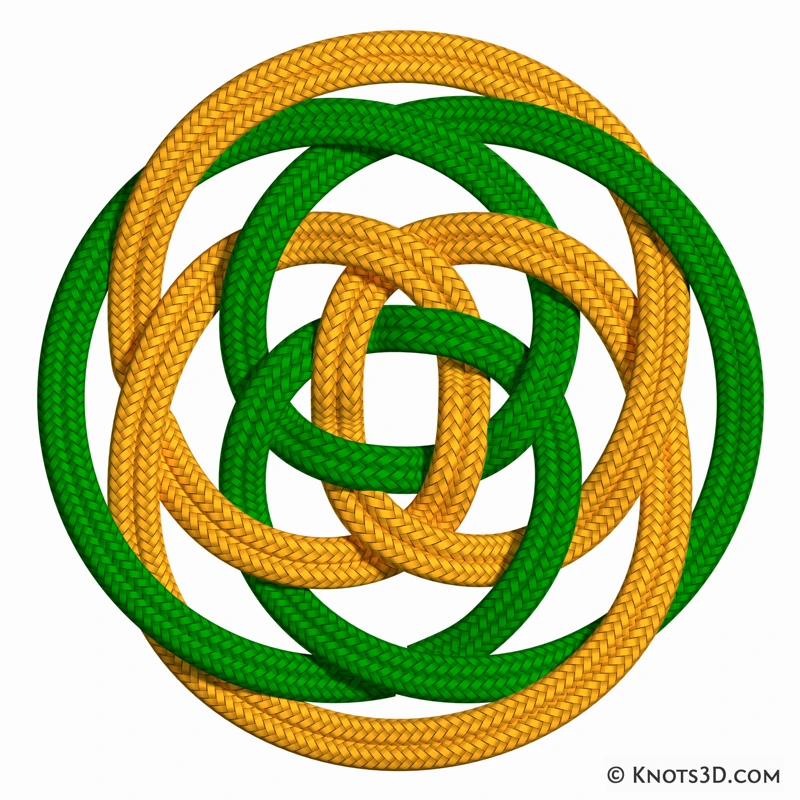
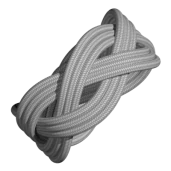
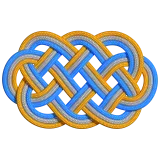
The Turk's Head Mat (6L4B) is a Turk's Head with six leads and four bights worked flat as a mat instead of around a pole. Unlike the smaller Turk's Head Mat (3L5B) and Turk's Head Mat (5L4B), it cannot be tied in a single line. Six and four are both divisible by two, and a Turk's Head whose lead and bight counts share a common factor closes on itself before the pattern is complete, so a line started on this mat meets its own end with only half the weave in place. The other half is laid in with a second cord, and each cord is then followed around its own course to double or triple the mat. Because it takes two cords, the mat is easily made in two colors, and each color then holds every other strand of the braid and every other scallop around the edge. The animation shown here uses two cords of different colors to show how they interweave. Laid flat it makes a round mat, and with two more leads than bights its braid is broad for the number of scallops around its rim. Worked in light cord it makes a coaster or a hot pad, and in heavier rope a flat fender to hang over the side of a small boat.
History
Clifford Ashley set out the rule that keeps this mat from being tied in one line in The Ashley Book of Knots (1944). A single-line Turk's Head is impossible, he wrote, when the number of leads and the number of bights have a common divisor, and if such a knot is attempted in one cord the working end and the standing end meet before it is complete, so it can be tied only as a knot of more than one strand. He called this the Law of the Common Divisor and recorded that George H. Taber discovered it at the same time as he did.
Structure
This Turk's Head is of the form 6 Lead, 4 Bight, or 6L4B in abbreviated notation, one lead more than the Turk's Head Mat (5L4B) on the same four bights. A lead is one complete circuit around the center of the mat, counted before any doubling pass, and the bights are the scallops around the edge where the line turns back. A Turk's Head can be tied in a single line only when its lead and bight counts share no common factor, and the number of cords it needs equals the greatest common divisor of the two. Six and four share the factor two, so this mat is made from two cords. Each cord makes three of the six circuits and two of the four bights on each rim, and the two alternate, so that neighboring leads and neighboring bights belong to different cords. Together they make the regular over one, under one weave of a Turk's Head.
Note
Tried in a single cord, this mat closes on itself halfway. The working end comes back to meet the standing end after three circuits, with only two of the four bights made on each rim, and the rest of the pattern has to be laid in with a second cord. Middle each cord and lay its course with one end, keeping the other end for the doubling passes. Lay the first cord in place, then weave the second through the gaps it leaves, with its bights falling between those of the first and every crossing taken over and under in turn. Working over pins on a board holds the first half in shape while the second goes in. Follow each cord around its own course a second or third time to double or triple the mat, keeping each new pass on the same side of the lead it follows. Finish the cords separately, drawing each pair of ends into the body of the mat and sewing or seizing them on the underside. Work the slack out evenly through both cords so that neither one pulls the weave out of shape.
Common Uses
- weave a flat, round decorative mat for a table or a shelf.
- make a two-color mat by tying each of its two cords in a different color.
- make a coaster or a hot pad for the table from light cord.
- make a flat rope fender to protect the side of a small boat.
Found in
