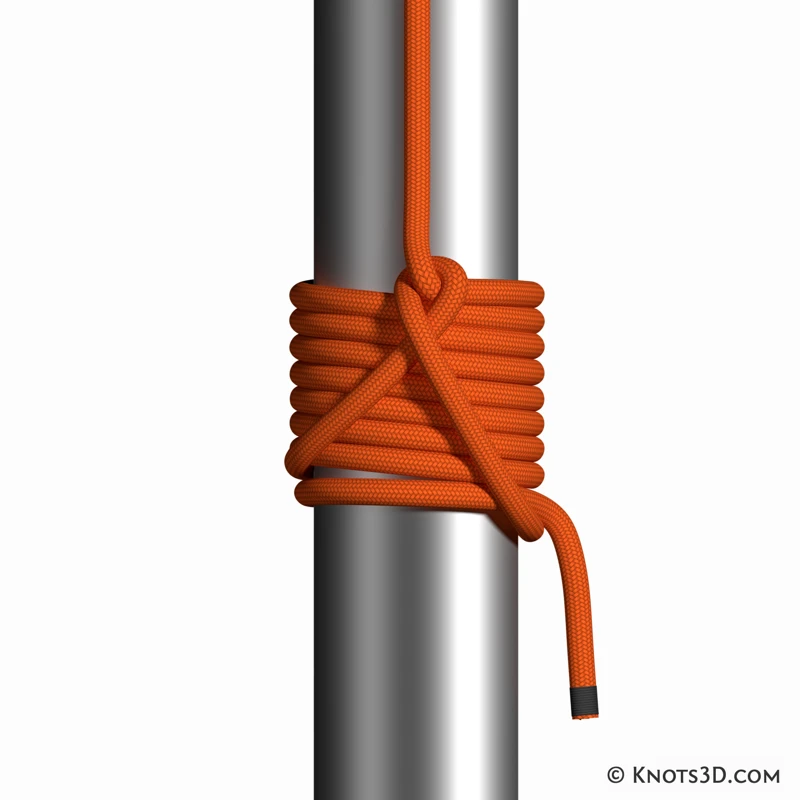


Description
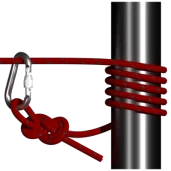
The Lifting Hitch grips a pipe, pole or spar when the pull runs along the object rather than perpendicular to it. Hoisting scaffold poles, a boat mast or any other smooth heavy cylinder requires a hitch with enough friction to hold a sustained lengthwise pull and still come off easily afterwards, and this hitch has both qualities. Six to eight turns are wound tightly downward around the object and the working end is then led back over the turns and secured to the standing part. The many turns spread the grip, which is what keeps the rope from sliding on varnished wood or metal spars where a Timber Hitch or a Killick Hitch may not hold.
History
Hitches of this pattern are recorded in A Fresh Approach to Knotting and Ropework, published by Charles Warner in 1992. Later knotting manuals carry the hitch under the name Lifting Hitch and present it as an alternative to the Timber Hitch and the Killick Hitch for raising a spar.
Structure
The Lifting Hitch is composed of six to eight turns wound tightly down the cylindrical surface in the opposite direction to the upward pull. The working end is then brought up around the standing part, then back down, finished with a half hitch.
Strength/Reliability
Holding power increases with the number of turns, and six to eight are usually sufficient. The friction from the large number of turns is what lets the hitch hold on varnished wood or metal spars, where a hitch relying on only one or two crossings might slip. The pull must be in the upward direction in line with the object being lifted and not down or perpendicular.
Warning
Verify tying technique with a skilled instructor where knot failure could cause property damage, injury, or death.
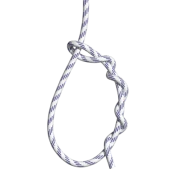
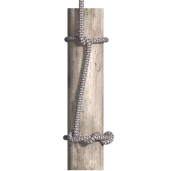
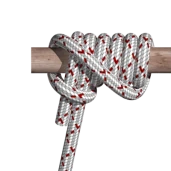
Common Uses
- hoist a length of pipe upright into position.
- pull a post or spar straight out of the ground.
- raise smooth pipe or conduit where an ordinary hitch would slip.
- take a lengthwise pull on a pole without crushing or marking it.
Found in

