Miller’s Knot
( Sack Knot | Bag Knot | ABOK #1241 )
Usage
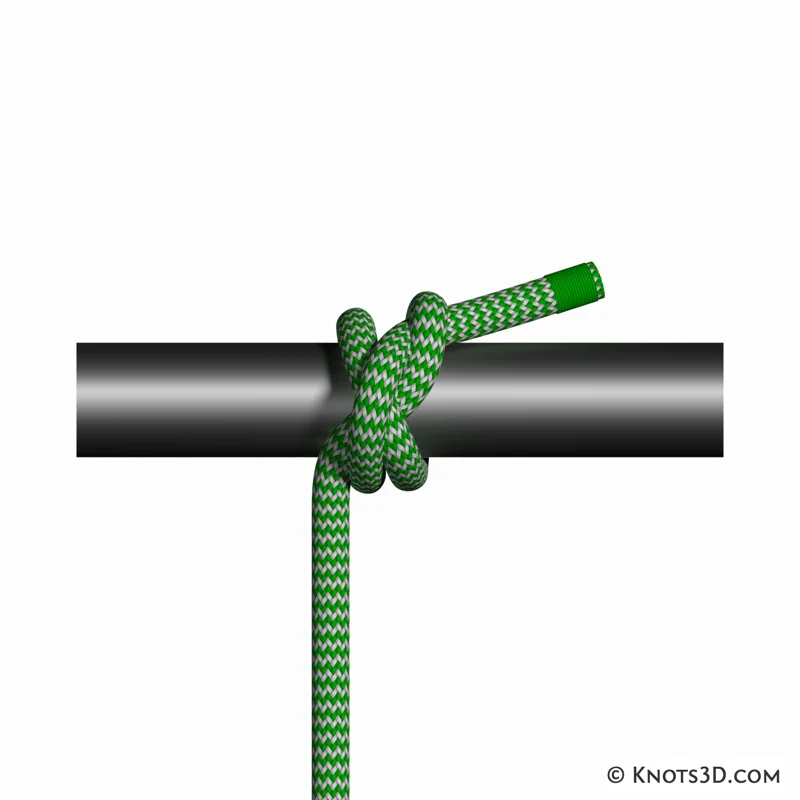
The Miller's Knot is a binding knot used to secure the neck of a sack, bag, or bundle. It belongs to a family of closely related knots that share the common purpose of cinching closed a gathered opening—the kind of task that was essential in the grain trade before the era of machine-sealed packaging. Today, the knot remains useful for bundling items, closing bags of all kinds, securing rolled materials, and any application requiring a compact binding that can be tightened firmly yet released without cutting.Beyond its traditional uses, the Miller's Knot has found a modern application in veterinary surgery, where it serves as a ligature for occluding blood vessels and pedicles. Its friction-based structure provides effective compression of tissue while remaining easier to adjust or reposition than more aggressive binding knots like the Constrictor.
History
The Miller's Knot takes its name from its historical association with the milling trade. For centuries, millers used knots of this type to secure the necks of large burlap or cloth sacks containing flour and grain. A reliable closure was essential—sacks had to withstand handling, stacking, and transport without spilling their contents, yet also needed to be opened without damaging the bag or requiring the cord to be cut. Clifford Ashley documented several variations of the Miller's Knot in The Ashley Book of Knots, noting that ABOK #1241 'is a fairly good Binding Knot that is often given in farm bulletins.' He also observed that any of the Miller's Knots can be tied in slipped form by using a bight for the final tuck rather than the working end, which 'saves the bag from being injured when the cord is being cut.'The knot was introduced to veterinary surgical training in 1973 and formally published for that application in 1985, where it has since become a standard technique for ligating vascular pedicles (dvm360.com).
Also known as
- Sack Knot
- Bag Knot
ABOK
- 1241
Structure
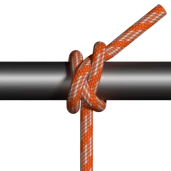
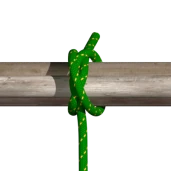
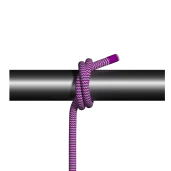
The Miller's Knot (ABOK #1241) is formed by making two crossing turns around the neck of the bag or object being bound, then tucking the working end under the first turn. The common pattern for this family of knots can be summarized as 'two crossing turns with the ends tucked under.' To tie: Pass the rope around the object and cross the working end over the standing part. Make a second turn around the object, laying it beside (not on top of) the first turn. Pass the working end over the crossing point and tuck it outward under the first turn. Tighten by pulling both ends. For a quick-release version, make the final tuck with a bight instead of the working end.
Strength/Reliability
The Miller's Knot provides good binding strength through friction—the two crossing turns grip effectively when drawn tight, and the structure tightens further under load. It is well suited for most binding applications on convex surfaces and performs reliably with natural fiber cordage. Ashley considered the Miller's Knot 'fairly good' but noted that the related Bag Knot (ABOK #1244) constricts better for demanding applications. For the most secure binding, the Constrictor Knot is superior, though it can be nearly impossible to untie after heavy loading. The Miller's Knot offers a practical balance: secure enough for most purposes, yet still releasable. In veterinary surgical testing, the Miller's Knot has demonstrated excellent holding security as a ligature, with performance well above physiologic requirements. However, some studies have noted that it may lose tension more readily than the Constrictor Knot once load is removed, making it better suited for applications where some adjustability is needed rather than permanent binding.
Note
Several distinct but related knots share the name 'Miller's Knot'. ABOK #1242 is a minor variation where the final tuck is made in the opposite direction. ABOK #1243 (also called the Sack Knot) is structurally the same as the Ground Line Hitch. ABOK #1244 (the Bag Knot) was noted by Ashley as having better binding characteristics than the others. The Constrictor (ABOK #1249) and Strangle Knot (ABOK #1239) have also been used as Miller's knots.