Get the app!


Details
TypeBinding
ABOK#1239
Also known as
Double Overhand HitchDouble Overhand KnotModified Miller's Knot
Description
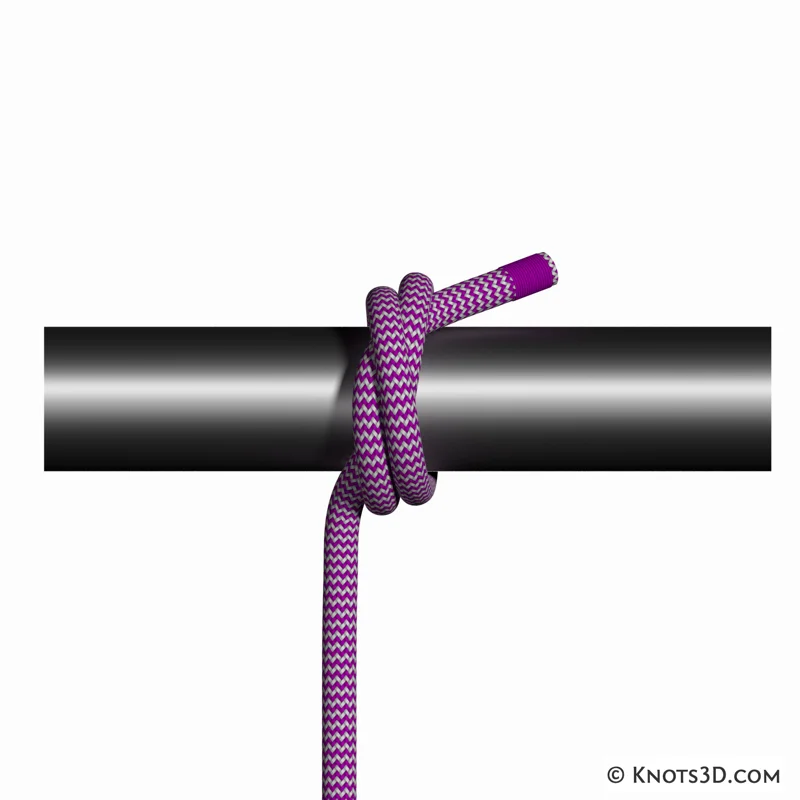
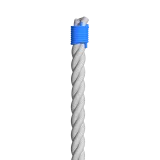
The Strangle Knot is a binding knot used to secure cylindrical objects such as rolled materials, the necks of sacks and bags, or the ends of ropes requiring a temporary whipping. It grips firmly when tightened and maintains a flat, low-profile shape that lies neatly against the bound object without bulging. The knot's primary applications include closing bags and sacks, bundling rolled items, and serving as a quick temporary whipping to prevent a rope's end from fraying. With one or two additional turns, it makes an excellent emergency whipping. Ashley specifically noted that the slipped version 'is one of the best for tying up sacks and meal bags.' The Strangle Knot has also found use in veterinary surgery as a ligature for blood vessels and pedicles, where it is sometimes called the Modified Miller's Knot.
History
The Strangle Knot appears in The Ashley Book of Knots as #1239, where Ashley describes it simply: 'The Strangle Knot starts with a round turn and the end is stuck under two parts. It may be used to tie up a roll.' The name likely derives from the knot's ability to grip tightly around an object.
Structure
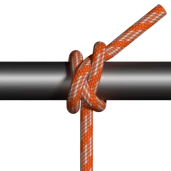
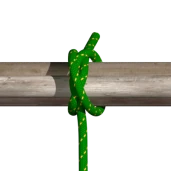
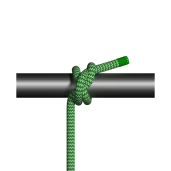
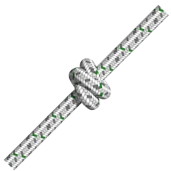
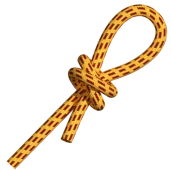
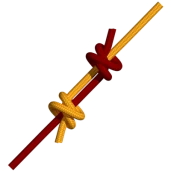
The Strangle Knot is formed by making two turns (a round turn) around the object, then tucking the working end under both turns. The result is an overhand knot structure beneath a riding turn, with the two ends emerging at the outside edges of the knot. This differs from the Constrictor Knot, where the ends emerge between the turns. The knot can be tied in two ways: by threading the end around an object already in place, or by forming a Double Overhand Knot in hand, twisting it into a figure-eight shape, and slipping the resulting double loop over the object before tightening. The knot can only be tied around cylindrical shapes—it requires a convex surface to grip properly.
Strength/Reliability
The Strangle Knot provides good binding strength and grips firmly on convex surfaces. It is less secure than the Constrictor Knot but easier to tie and, in some cases, easier to release. Like the Constrictor, it can be very difficult to untie after heavy loading—a knife may be necessary. When cutting the knot free, the binding strand should be cut over the underlying material to avoid damaging what is being bound. For the most secure binding, the Constrictor Knot is superior, but the Strangle Knot is adequate for most temporary applications and has the advantage of a flatter profile. In veterinary surgical testing, the Strangle Knot tightened readily and achieved excellent holding pressures as a ligature, though some studies found it did not retain tension as well as the Constrictor once load was removed. For quick-release applications, the slipped version (made by tucking a bight rather than the working end) allows easy untying while still providing secure holding.
Common Uses
- bind a bag, hose, or tube tightly closed.
- temporarily secure the end of a rope to prevent unraveling.
- clamp two objects together with a tight binding.
- tie off the neck of a sack for storage or transport.
- serve as a surgical ligature in veterinary or medical procedures.
- bind tightly around a cylindrical object like a pipe or dowel.
Found in

