Get the app!


Details
TypeHitches
Also known as
Easy Spade Hook KnotSpade End KnotSpade End Hook KnotPallet Hook KnotPaddle Hook Knot
Description
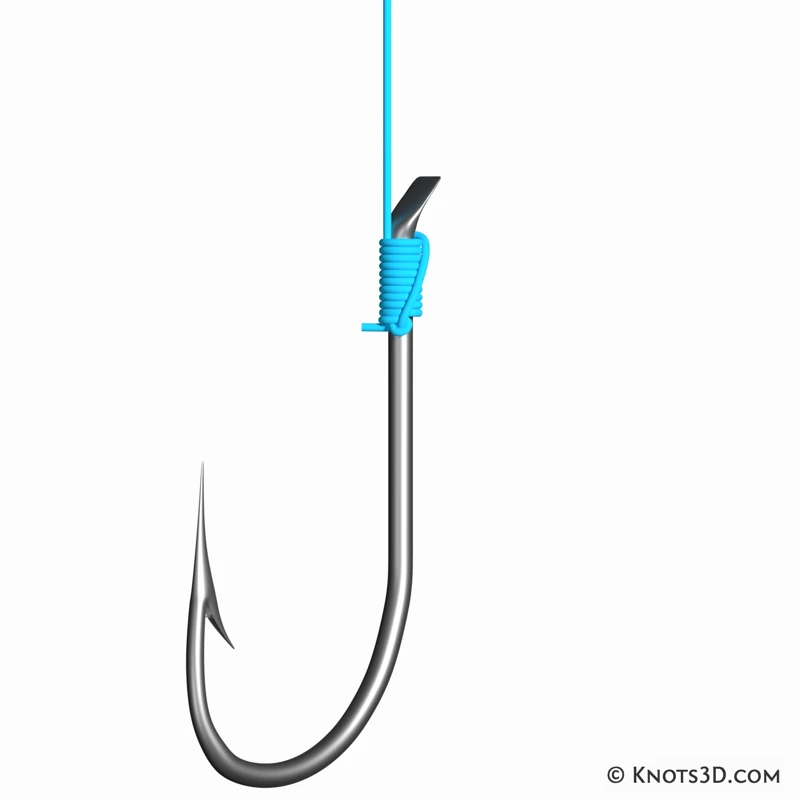
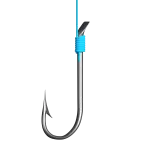
The Spade Hook Knot (Method 1) attaches a line to a hook whose shank ends in a flattened spade instead of an eye. The line is laid along the shank and a series of turns is taken around both the shank and the line itself, so the finished knot grips by friction along the shank and is drawn up snug beneath the spade. Because the pull runs straight down the shank rather than around an eye, the hook hangs straight and the line is not bent sharply at the point where it takes the load. The same knot will also secure a short leader to a heavier main line. Anglers who make up their own hook lengths can match hook size to line strength and choose the length of the leader, neither of which a shop tied hook allows.
History
Spade end hooks were made before hooks were given eyes, and the knot that secures them is a whipping rather than a knot in the ordinary sense. German angling literature treats the spade hook knot as a family rather than a single knot, with the Domhof and a clinch form named as members of it. The English names Pallet Hook Knot and Paddle Hook Knot both reference the flattened blade at the end of the shank. Pallet is the same word as the French palette, a diminutive of pale, meaning a blade or spade, and the French call the hook itself an hameçon à palette. Paddle arrives at the same image by a separate route, from a Middle English word for a small spade.
Structure
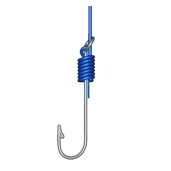
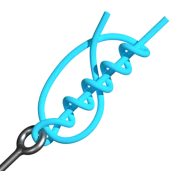
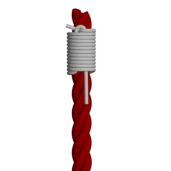
This method of tying the Spade Hook Knot runs the line along the shank and forms a small loop at the hook end. Turns are then wrapped back toward the spade, each one enclosing the shank together with the standing part. The end is drawn across the turns and tucked back through the loop at the hook end, and the standing part is then drawn up, which locks the working end in the loop. Around five turns suit a small hook, and more are taken on a large one.
Strength/Reliability
Tied in monofilament this form holds very well. Its hold comes from the number of wraps along the shank rather than from any single tuck, so adding turns provides additional security.
Note
The line must leave the knot on the inside of the out-turned spade rather than the outside, or the edge of the spade will bear on the line and cut into it under load. Wet the turns before drawing them up so they tighten without burning. Slide the finished knot up until it sits just beneath the spade, then trim the tag end short.
Common Uses
- tie fishing line directly to a hook that has no eye.
- attach a short leader to a heavier main line.
- keep the pull in line with the hook shank for a better hookup.
- tie rigs and snoods at home so they are ready to fish.
Found in
