Get the app!


Details
TypeHitches
Also known as
Inner Snell KnotSpade End KnotSpade End Hook KnotPallet Hook KnotPaddle Hook Knot
Description
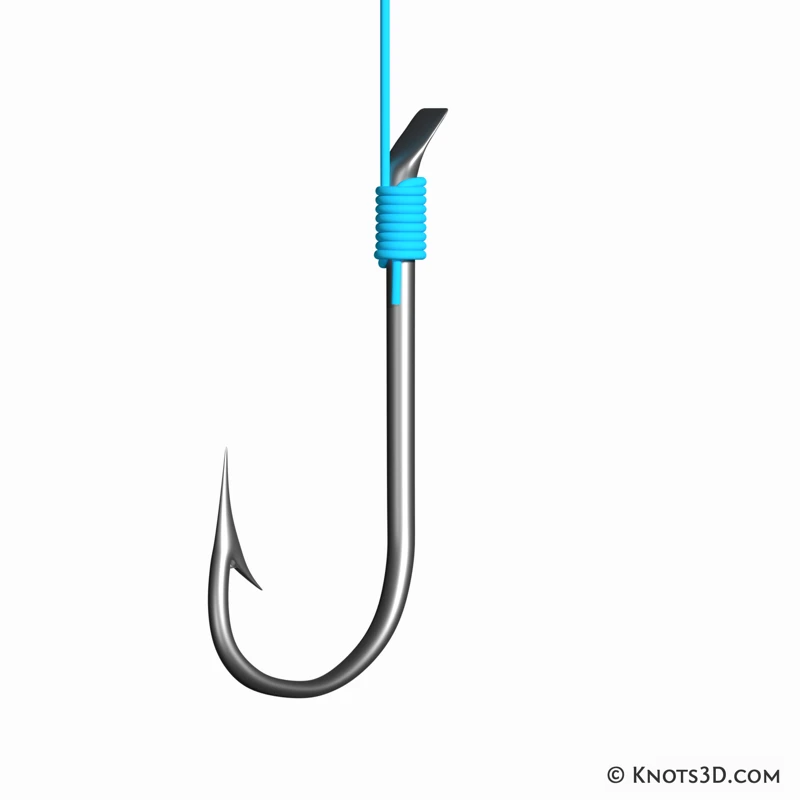
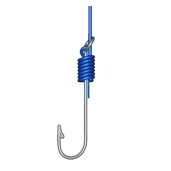
The Spade Hook Knot (Method 3) attaches a line to a hook whose shank ends in a flattened spade instead of an eye. Like the other methods it binds the line along the shank, so the pull runs straight down the shank and the hook hangs in line with the fishing line.The methods differ in how their turns are made. Method 2 is tied in the same way as the Common Whipping, and Method 3 is tied in the same way as the Perfect Whipping, an improved form of it. Hook knots of this kind share their structure with whippings, and both clamp down on whatever they are wrapped around.Anglers who tie their own hooks can pair each hook size with a suitable line strength and choose the length of the leader.
History
Snelling, in which the line is bound along the shank of a hook rather than tied to an eye, was first used on hooks that had no eye, and it remains in use on spade end hooks.In Japan the inside-wrap knot (uchikake musubi) and the outside-wrap knot (sotokake musubi) are taught as the two basic hook knots, and the tackle maker Yamaria describes them as the basic form of every other way of tying line to a hook. According to a Japanese angling magazine, most hooks sold there ready tied to a length of line use the inside wrap. Daiwa's guide for beginners ties it as shown here, by wrapping the loop itself around the shank, while Yamaria threads the end through the loop on every turn. The line maker Varivas gives the pair in English as the Inner Snell Knot and the Easy Snell Knot.
Structure
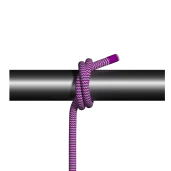
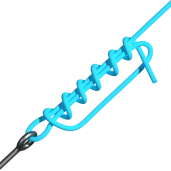
This method of tying the Spade Hook Knot stands to the Perfect Whipping as Method 2 stands to the Common Whipping. Each is tied in the same way as its whipping and shares its structure, though not its purpose, since a whipping binds the end of a rope against unraveling and a hook knot does not. In both, the turns clamp down on what they enclose. In the whipping that is the rope, and on the hook it is the shank together with the standing part of the line laid along it.The Perfect Whipping is in turn based on a Strangle Knot taken with many turns, a multiple overhand knot that encloses whatever it is tied around. On the hook it encloses the shank and the line's own standing part. In the whipping both ends of the twine lie along the rope beneath the turns, pointing in opposite directions, so neither has to bend sharply back on itself as the end of a Common Whipping does. The turns are made the same way as in the whipping. The line is laid along the inside of the shank and formed into a loop, and the loop itself is passed around the shank and the line once for each turn, about five turns in all, before the standing part is drawn up to tighten them. The same knot can also be tied by passing the end through the loop on every turn, the way a Uni Knot is made. On the hook the end and the standing part lie along the shank in the same way as the two ends of the whipping. The standing part leaves the turns at the spade end, on the inside of the out-turned spade, and the end is trimmed short.
Strength/Reliability
Angling sources, which know this form as the inside-wrap knot, disagree on how it compares with the outside-wrap form, Method 1. A line maker describes it as more stable and stronger, and an angling magazine rates it the stronger and more reliable of the two when correctly tied. A tackle maker notes that it holds consistently even when tied by a beginner and resists abrasion, but that thick line may not draw up fully.One angler's head-to-head pull test, in fluorocarbon with six turns on each knot, found the reverse. The inside-wrap knot lost all three pulls against the outside-wrap knot, slipping out once and breaking twice, and the tester rated it 0.8 against 1.0. The tester attributed this to its turns tightening less under load than those of the outside-wrap knot, so that the knot slips and the line can chafe through against the spade.
Note
Make the loop large enough to pass around the hook for every turn, because each turn uses up part of it. Daiwa gives this way of making the turns, with the loop passed around the hook rather than the end threaded through it, for a short hook length. Keep the line on the inside of the shank, the side toward the point, so that it leaves the knot on the inside of the out-turned spade. A line leaving on the outside is pressed against the edge of the spade and can be cut by it under load. Lay each turn tightly beside the last without letting it ride over the one before, and keep the parts of the line beneath the turns parallel. Before drawing the knot up, slide the turns up until they sit just beneath the spade, because the knot is hard to adjust once it is tight. Wet the turns, draw up slowly on the standing part and the end, and trim the end short.
Common Uses
- tie fishing line directly to a spade end hook that has no eye.
- bind the line along the hook shank so the pull runs straight to the point.
- attach a hook with turns that clamp down tightly on the shank.
- make up hook lengths at home, matching the hook size to the line strength.
Found in
