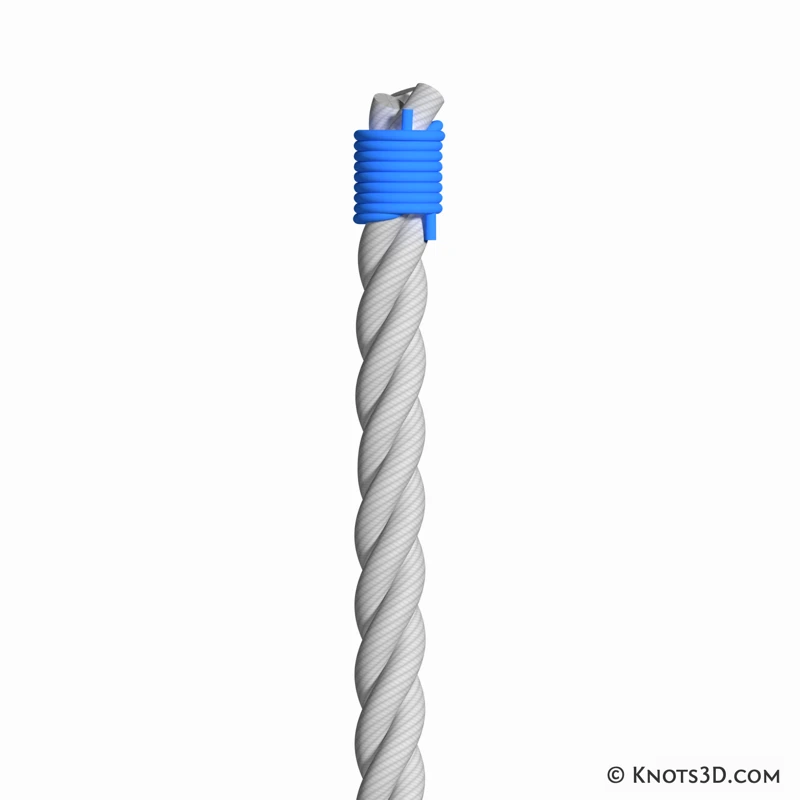


Description
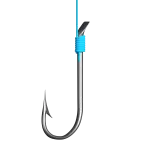
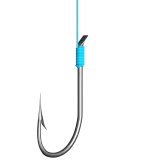
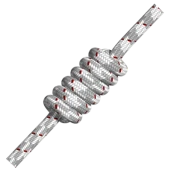
The Perfect Whipping binds the end of a rope with twine to keep it from fraying. It is an improved form of the Common Whipping that does away with the sharp bends, or elbows, that the common method leaves in its twine. A common whipping locks one end of the twine through a loop that is then drawn under the turns, so the twine doubles back on itself beneath the wraps. For the Perfect Whipping, both ends of the twine are laid along the rope side by side, pointing in opposite directions, and the turns are made over them with a long loop of the twine that is passed over the rope's end once for every turn. Once it is pulled tight, each end runs straight out from under the turns, one at each end of the whipping. The result is a Strangle Knot with many turns. Like the common method, it needs no needle or other tools. The same construction, made in fishing line around the shank of a hook, serves as a snell in the Spade Hook Knot (Method 3).
History
The Perfected Whipping appears under that name in Geoffrey Budworth's The Ultimate Encyclopedia of Knots & Ropework (1999). Budworth presents it as an improved version of the common whipping that eliminates that method's 'harsh elbows'. Discussions on the International Guild of Knot Tyers forum in 2010 and 2011 connected it with two related practices, the Strangle Knot made with extra turns as a whipping and the snell that anglers use to fasten a hook.
Structure
The Perfect Whipping is a Strangle Knot made with many turns, and the Strangle Knot is itself a Multiple Overhand Knot that encloses an object, here the end of the rope.The same wrapping, made in fishing line around a hook shank, is the snell used in the Spade Hook Knot (Method 3), just as the Spade Hook Knot (Method 2) follows the structure of the Common Whipping.
Note
Allow a loop of twine long enough for the whole whipping, because every turn passes over the rope's end and uses up part of the loop. Start the turns at the end of the whipping farthest from the rope's end and work toward it, keeping the two laid parts of the twine parallel and together underneath. The loop picks up a twist as it goes around the rope. Shake the twist out as the loop shrinks, or put an opposite twist into the loop before starting so that the turns remove it. Pull on the end of the twine to take all the slack out of the last turn, then pull steadily on both ends to tighten the whipping and trim them close.
Common Uses
- whip the end of a rope with twine to stop it from fraying.
- finish a rope end with a neat whipping whose twine has no sharp bends.
- whip a rope end using only twine, with no needle or other tools.
Found in
