Get the app!


Details
TypeBends
ABOK#1436
Also known as
One-Way Sheet BendFigure Eight Becket BendFigure Eight Sheet Bend
Description
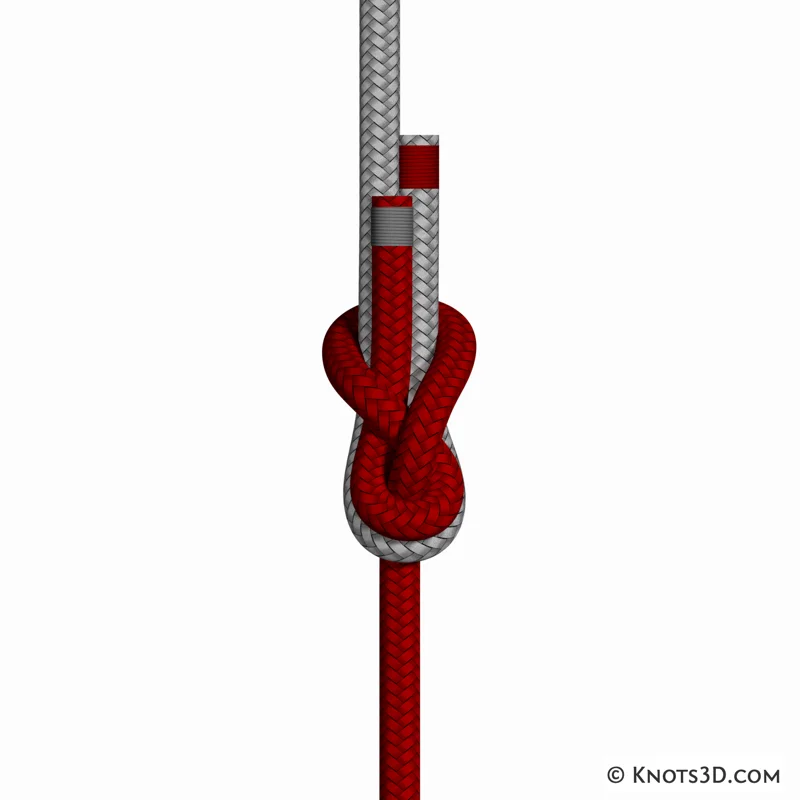
The Tucked Sheet Bend is a thoughtful modification of the classic Sheet Bend, designed for situations where ropes may be dragged over rough ground, pulled through rocky crevices, or towed through water. By tucking the working ends, this knot minimizes the risk of snagging—the three short ends are best oriented to point away from the direction of pull, reducing the likelihood they'll catch against obstacles or be disturbed by wind or current. This adaptation is especially recommended for towing or hauling, as the tucked ends create a sleeker knot profile, ensuring the joined ropes pass smoothly over obstructions. The knot remains easy to untie when not under heavy load, yet provides extra security and reliability compared to the standard Sheet Bend, particularly when joining ropes of unequal size in outdoor, marine, or utility use. Always position the short ends in the direction opposite to the load to maintain the knot's streamlined effect and prevent snagging while dragging or towing.
History
The Tucked Sheet Bend, specifically depicted as #1436 in The Ashley Book of Knots (1944), represents an evolutionary refinement of the classic Sheet Bend (ABOK #1431). While Ashley does not assign a date or inventor to this specific variation, it emerged from maritime traditions seeking enhanced security for rope joins. Its history is deeply connected to seafaring and boat work, evolving as sailors and riggers encountered the limitations of simpler bends. Knotting expert Geoffrey Budworth calls the Tucked Sheet Bend the One-Way Sheet Bend. Sailor and author Frank Rosenow, also calls the knot the Tucked Sheet Bend and illustrated it in his book, Seagoing Knots (1990).
Structure
The Tucked Sheet Bend is the same basic structure as the standard Sheet Bend but has an extra tuck which forms a figure eight and why the knot is sometimes called a Figure Eight Sheet Bend or Figure Eight Becket Bend
Strength/Reliability
The Tucked Sheet Bend increases the security of the classic Sheet Bend by directing the working end back under itself, forming an additional tuck alongside the two standing parts of the other rope. This structure significantly reduces the risk of the knot working loose or the ends snagging when dragged across rough ground or through obstructions.
Warning
Verify tying technique with a skilled instructor where knot failure could cause property damage, injury, or death.

Common Uses
- join two ropes with extra security by tucking the tail under.
- connect two ropes of different thickness where added security is needed.
- join ropes for towing or hauling over rough ground without snagging.
Found in

