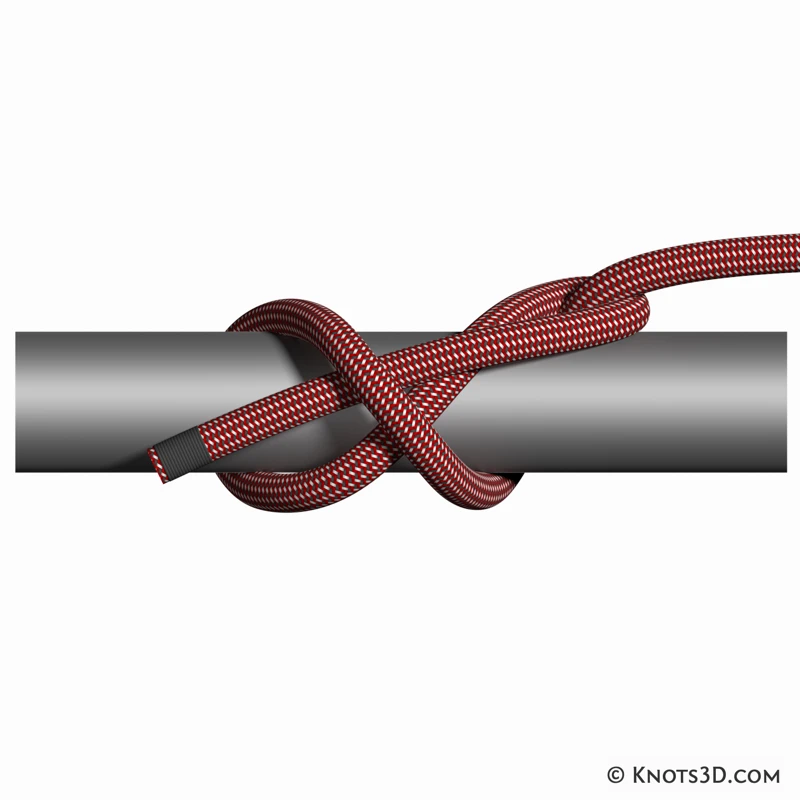


Description
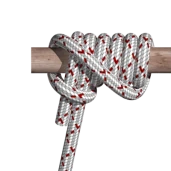
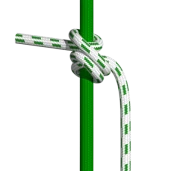
The Clara Hitch joins a thin rope to a much thicker one and holds against a pull running along the thicker rope's length. It is traditionally tied with two turns of the standing part, finishing with the working end. Made into the middle of a rope rather than at its end, the whole hitch is tied with the working end instead. Two turns hold well on rope, but more turns are required for a smooth surface like a metal pole or wooden spar. The Clinging Clara Hitch, Queen Clara Hitch and Great Queen Clara Hitch each carry that idea further. Attached to a length of thicker rope, it also makes a comfortable handhold when pulling hard on a thin line.
History
The Clara Hitch is the first of a family of gripping hitches devised by Dr. Harry Asher, a British research scientist and member of the International Guild of Knot Tyers (IGKT). Asher first published the family in A New System of Knotting, issued in two volumes for the Guild in 1986, and brought it to a wider audience in The Alternative Knot Book of 1989, where this knot appears simply as the Clara Hitch. Writing in IGKT's Knotting Matters in October 1989, Asher himself referred to knots tied on the same lines as a 'Clara' or a 'Queen Clara'. The later literature is less consistent. Geoffrey Budworth's Ultimate Encyclopedia of Knots of 1999 prints this same hitch under the name Clinging Clara, while Nic Compton's Knot Bible of 2013 lists the family as the Clinging Clara, the Queen Clara and the Great Queen Clara. Why Asher chose the name Clara is not documented, and he never explained it. His other coined knot names include the Simple Simon and Vice Versa bends.
Structure
The Clara Hitch is made by taking two turns round the thicker rope. Asher made them with the standing part of the thin line and finished with the working end, though a hitch tied into the middle of a rope is made entirely with the working end. The working end is then wrapped and tucked round its own standing part and beneath the second of the two turns. Further turns may be added. Two hold on rope and four are enough on a smooth spar. The Clinging Clara Hitch takes the same form but tucks the end beneath two knot parts instead of one.
Strength/Reliability
The Clara Hitch holds by friction, and its grip is governed directly by the number of turns. As Asher put it, 'the grip produced increases dramatically with more turns'. Two turns hold well on rope but not on a spar, while four suffice on smooth timber, and an extra turn or two adds a margin of safety. Like other gripping hitches it is only secure while the pull tension is maintained, and the load must be taken on the standing part.
Warning
Verify tying technique with a skilled instructor where knot failure could cause property damage, injury, or death.
Common Uses
- join a thin line to the end of a much thicker rope.
- attach a light line to a hawser so it can be hauled lengthwise.
- make a comfortable handhold by hitching a line onto a short length of thicker rope.
- grip a smooth spar by adding extra turns to the hitch.
- rig a messenger line onto a heavier rope before hauling it across.
Found in
