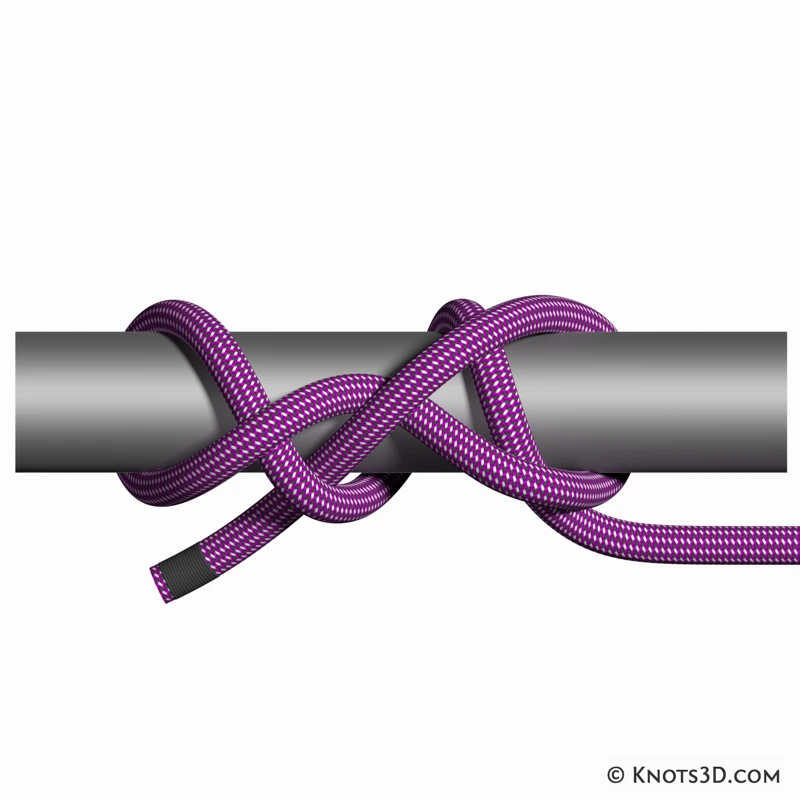


Description
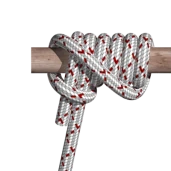
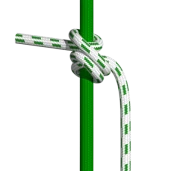
The Queen Clara Hitch is a stronger variant of the Clara Hitch. Two turns are taken round the rope or spar, the working end is carried back beyond its own standing part and round once more in the opposite direction, and is finally tucked over two parts and under one. The opposed turn distinguishes it from the base Clara. The last turn locks against the first two rather than adding to them. The Queen Clara is able to withstand greater strains than the basic Claras. On a laid rope the first two turns should ideally bed down between the strands.
History
The Queen Clara Hitch is one of three Clara knots Dr. Harry Asher published in 1986 in A New System of Knotting, and the one he named most often himself. Writing in Knotting Matters in October 1989, he referred to knots tied on the same lines as a 'Clara' or a 'Queen Clara'. Nic Compton describes it in The Knot Bible as a development of the Clinging Clara that is 'said to be stronger and more secure'. The word Queen appears to mark an upgraded Clara rather than any actual queen. No source records why Asher chose the name Clara in the first place.
Structure
Two turns are taken round the spar or rope, following the lay if it is laid rope. The working end is then brought back beyond its own standing part and passed round once more in the opposite direction to the first two turns, and finished by tucking it over two parts and under one. The opposing turn is the essential feature and the Great Queen Clara Hitch applies the same finish over at least six turns.
Strength/Reliability
Reversing the final turn against the first two gives the Queen Clara Hitch a firmer grip than either the Clara Hitch or the Clinging Clara Hitch, and it is generally acknowledged to be the stronger and more secure of the family's smaller forms. It grips by friction and holds only while tension on the standing part of the rope is maintained. Tied on laid rope, bedding the first two turns between the strands improves its hold.
Warning
Verify tying technique with a skilled instructor where knot failure could cause property damage, injury, or death.
Common Uses
- attach a line to a spar or a large rope for a lengthwise pull.
- rig a messenger line onto a hawser before hauling it across.
- take a heavier strain than the plain Clara Hitch will hold.
Found in
