

Description
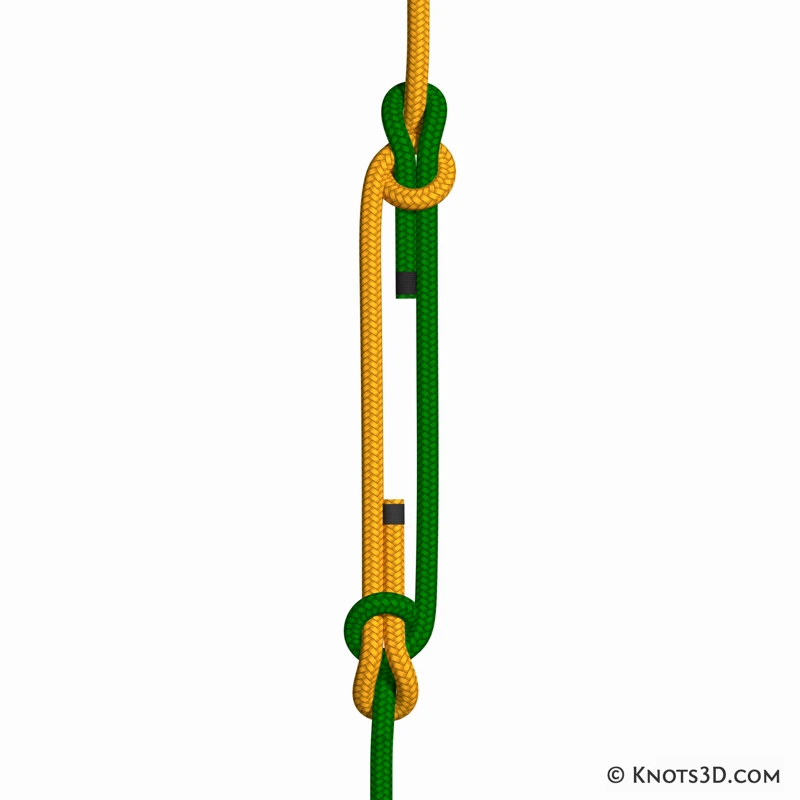
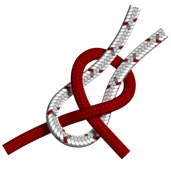
The Twin Bowline Bend joins two ropes or hawsers by tying a Bowline in each end around the standing part of the other rope. The two ropes finish lying parallel rather than crossing, which is the whole point of the knot. It avoids the sharp joint of the Bowline Bend and is a better choice because there is no crossing point for the two lines to chafe against.It is suited to heavy, stiff rope, including mooring lines, towlines and large diameter cables and hawsers. The difficulty is getting the legs to equal length. The working ends need to be left generously long, and the bend consumes more rope than simply linking two loops.
History
Ashley recorded the twinned form at #1454 in The Ashley Book of Knots, immediately before the Bowline Bend at #1455, and credits no inventor. It is mentioned in modern references as the Twin Bowline Bend. Nic Compton coined the term 'Yin-Yang Bowline' in his book The Knot Bible referring to the knot configuration similarity to the Yin-Yang Chinese philosophy of complementary and opposed forces, and suggested it be tied in black and white rope.
Structure
The Twin Bowline Bend is composed of two symmetric Bowline structures. However, the loop of each Bowline encircles the standing part of the other rope. Because the standing parts run parallel through the joint, they each take an equal share of the strain on the loaded knot. Neither knot is levered sideways the way the interlocking Bowline Bend is.
Strength/Reliability
The Twin Bowline Bend is stronger than the interlocking Bowline Bend, and the reason is structural. Interlocked loops meet at sharp crossings that rub on each other, while the twinned form has no frictional crossing at all, so the load runs through parallel standing parts that each take an equal share of the strain.Security and reliability are the same as the ordinary Bowline. Both knots still untie readily once the tension is removed. Leave the working ends long.
Note
Arrange the two lines parallel with the working ends opposed before starting. Leave the ends long, and adjust the finished knots so the legs are of equal length.
Warning
Verify tying technique with a skilled instructor where knot failure could cause property damage, injury, or death.
Common Uses
- join two thick mooring lines, hawsers or towlines.
- connect large diameter cable that is too stiff for a compact bend.
- join two ropes where the joint will stay loaded and moving for a long time.
- extend a heavy line without the chafe of two interlocking loops.
Found in
