

Description
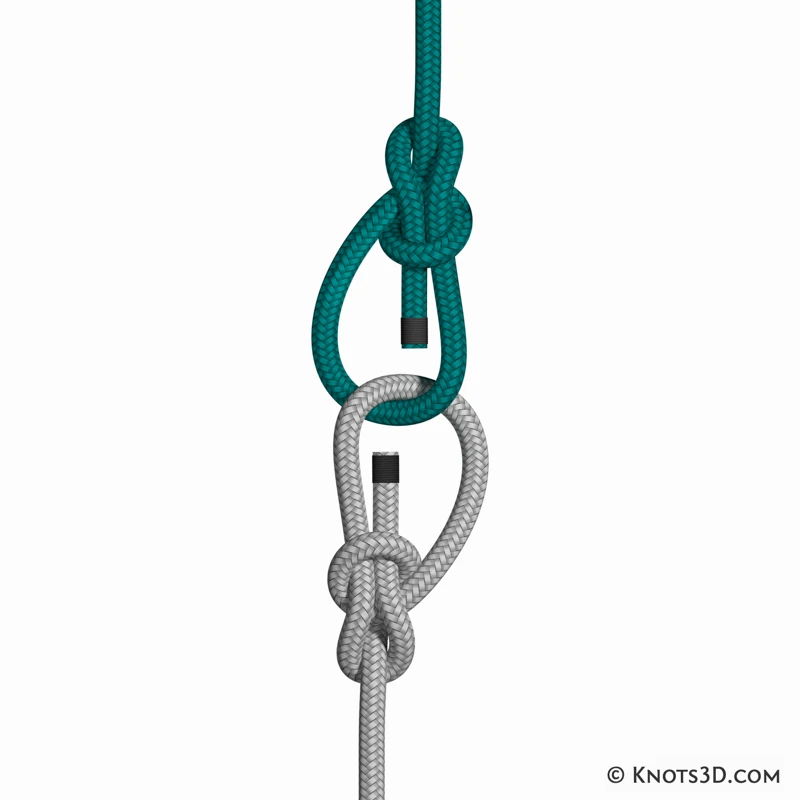
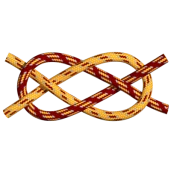
The Bowline Bend joins two ropes by tying a Bowline in each end and passing each loop through the other. Nothing new has to be learned, which makes it immediately useful to anyone who already knows the Bowline. It will join lines of dissimilar diameter, construction and material, and because the Bowline neither slips nor jams under tension, the two ropes can usually be separated again without difficulty. At sea it is the traditional way to join hawsers, the large diameter heavy ropes and steel cables that big ships use for mooring, towing and anchoring.The downside to this joining method is wear on the rope. The two loops meet at roughly a right angle and bear on each other across a small area, so the joint will chafe at that point. For a more permanent connection that will stay under tension, the Twin Bowline Bend may be a better choice.
History
In the days of natural fiber rope it was standard advice at sea that hawsers should be joined with a pair of interlocked Bowlines, and the recommendation still holds with some modern rope. The virtue that made the pairing attractive is that the Bowline does not slip or jam even under tension. Ashley cataloged the bend at #1455 and traced it to Richard Henry Dana, Jr., who recorded it in his 1841 work The Seaman's Friend. The twinned form sits alongside it at #1454 and carries no attribution at all.
Structure
Each rope forms a simple Bowline, and each Bowline's loop encircles the loop of the other. The two loops interlock like two links of a chain and come to rest at roughly a right angle to one another. Load is carried from one standing part, through the first loop, across the crossing point, through the second loop and out along the other standing part.The crossing point is the whole of the joint. Everything else is a Bowline behaving exactly as it does on its own, which is why the bend inherits the Bowline's good and bad qualities without modifying either.
Strength/Reliability
The joint is no stronger than the weaker of its two Bowlines, and the Bowline is not among the most reliable of loop knots. Against that, it does not slip or jam even under tension, so it can be cast off after heavy loading. Improved variants such as Scott's Locked Bowline or the Edwards Bowline will mitigate some of the common Bowline's failings.However, the real limitation of this joining method is chafe rather than breaking strength. The two loops may be weakened where they cross and rub against one another, and repeated movement under load will wear both at that point. Inspect the crossing on any joint that has been left working for a long period.
Warning
Verify tying technique with a skilled instructor where knot failure could cause property damage, injury, or death.
Common Uses
- join two mooring lines that must be separated again once the load is removed.
- extend a rope by tying a Bowline in each end and linking them.
- connect two ropes of different diameter or material.
- join two hawsers for towing a ship.
Found in
