

Description
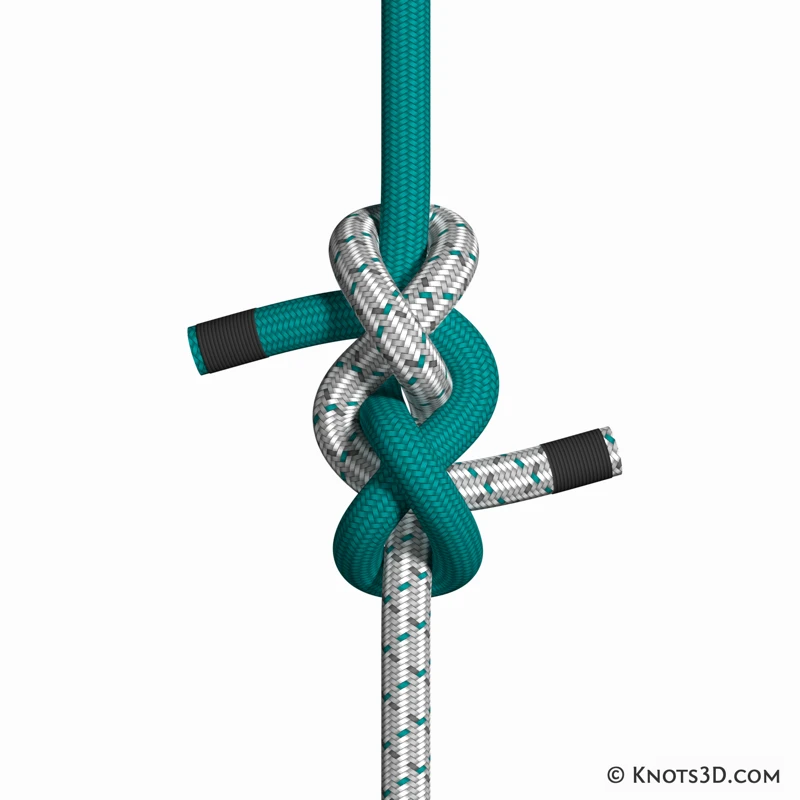
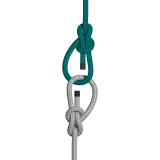
The Symmetric Hawser Bend (Under) is the companion to the Symmetric Hawser Bend (Over) and is the better of the two. A hawser is the large diameter heavy rope or steel cable that big ships use for mooring, towing and anchoring. The outside loops close into single hitches rather than passing the working end over its standing part, and that one change is what lets it hold lines that differ in size or construction. Its inventor expected it to prove the more useful of the pair.Like its companion it finishes flat and symmetrical, with gentle curves that suit large ropes and cables, and it can be loosened by raising a loop at either end. It is a working bend for heavy rope rather than a general purpose knot, and it earns its place where a joint must run through the guides on deck or wind neatly onto a winch.
History
Jack Reinmann of Ohio submitted this bend and its companion to the International Guild of Knot Tyers, and both appeared in Knotting Matters issue 43 in the summer of 1993. They descend from Ashley's Hawser Bend, number 1450 in The Ashley Book of Knots, which Brion Toss had recommended in The Rigger's Apprentice. Reinmann found an old note of his own showing how to alter that knot's final tuck to make it symmetrical, and called the result the Symmetrical Hawser Bend. He was encouraged by a principle Harry Asher had reported from the inaugural meeting of the Guild in London, that a symmetrical knot is likely to be a good one. This is the second of the pair. After further work on the first form Reinmann arrived at it and judged that it would prove the more useful of the two, being the sounder choice on ropes that do not match.The word hawser reached English around 1300 from the Anglo-French hauceour, a hoister, which goes back through Middle French haucier, to hoist, to the Latin altus, meaning high. A hawser was first the rope you raised something with, and only later the heavy line a ship moors, tows and anchors by.Its resemblance to hawse, the part of a bow that carries the anchor cables, is not a shared origin. Hawse came separately from the Old Norse hals, a neck. The two words did grow together in English all the same. Hawser was reshaped by association with hawse, and a hawser is in practice the rope that runs out through the hawseholes.
Structure
A bight is formed in one rope and twisted to form two tight curves. The working end of the second rope is then interwoven, passing outwards over one part, under two, over two and under one, then returning over one, under one, over one, under one, over one and under one.The difference that matters is at the outside loops. Here each closes into a single hitch, with the working end nipped under its own standing part rather than passing over it. That single hitch is the same structure that does the gripping in the Sheet Bend and the Bowline, and it is a firmer hold than the exit nip both forms share.
Strength/Reliability
This is the stronger holding of the two forms, and the reason is the single hitch at each outside loop. Both forms nip the working ends under their standing parts on the way out of the knot, which helps hold them together, but that exit nip alone is not as strong as a closed single hitch.The difference shows on mismatched rope. Joining three sixteenths of an inch of smooth braided dacron to half an inch of three strand nylon, the single hitch held the thin rope firmly and the knot did not slip, where the Over form let it pull straight out. Reinmann rated the bend on a par with other good bends, leading fairer than most and distorting minimally under load, while noting that it had yet to be thoroughly tested. Treat extreme mismatches as outside its range.
Warning
Verify tying technique with a skilled instructor where knot failure could cause property damage, injury, or death.
Common Uses
- join two hawsers that are not quite the same size.
- connect ropes made in different ways, such as a twisted rope to a braided one.
- join heavy cable where the two lines do not match well.
- make a flat, symmetrical joint in large rope under a steady pull.
Found in
