

Description
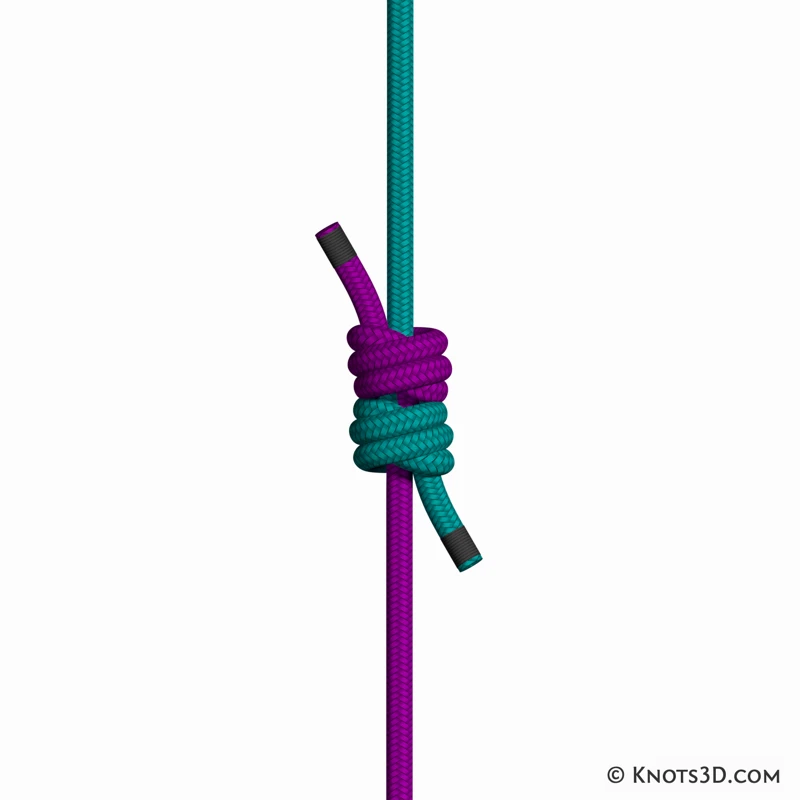
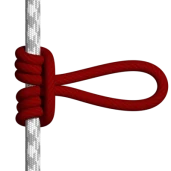
The Triple Fisherman's Knot is a bend for joining two ropes, or the two ends of one cord to make a closed loop. It is tied like a Double Fisherman's Knot but with triple overhand knots in place of double ones, and it suits thinner, springier or more slippery lines. It is used mainly in climbing, tree climbing, caving and rope rescue, with slippery or stiff high-strength cords such as those made with Dyneema, Spectra, Kevlar or Technora. Loops of these cords serve as Prusik loops and as long loops for building climbing anchors.Each extra turn makes the bend more secure in slippery line but harder to untie. In tests on high-strength cords the extra turn stopped the slippery core from pulling out of the knot. In ordinary nylon cord the double holds as well as the triple, and some references consider the double adequate even in Dyneema.Like the double, the Triple Fisherman's Knot jams under load, so it suits joins that are meant to stay tied. Leave long tails, at least ten times the diameter of the rope in rescue work. Rescue guidance accepts the double or triple fisherman's for ropes that hang clear of the ground, but prefers a Flat Overhand Bend or its doubled form where the join will be dragged over ground or edges.Anglers also tie the triple, and sometimes a quadruple, to join two lengths of smooth fishing line.
History
Fisherman's bends with three turns in each half were tied by the Inuit of Greenland in fishing lines of baleen. Baleen is the horn-like plating in a whale's mouth, and split into flat, smooth strips it behaves much like a stiff monofilament. Knots in baleen excavated by H. C. Gulløv near Nuuk and carbon dated to about A.D. 1700 include a Triple Fisherman's Bend. An artifact from Disko Bay given to the National Museum of Denmark in 1854 also has fisherman's bends made with triple overhand knots. Pieter van de Griend described these finds in his chapter 'Inuit Knots' in History and Science of Knots (1996). He explained that single overhand knots pull through in baleen, so more turns were needed for grip, and argued that the multiple fisherman's bends were most likely an indigenous Inuit development rather than a borrowing from European sailors.Climbers came to recommend the triple for the stiff Kevlar cord once used to string chocks, and the advice carried over to the high-strength cords later used for cordelettes and Prusik loops. In 2000 Tom Moyer, Paul Tusting and Chris Harmston put this and related beliefs about high-strength cord to the test in a paper for the International Technical Rescue Symposium.
Structure
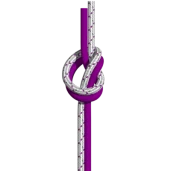
The Triple Fisherman's Knot is made of two Triple Overhand Knots, each tied in its strangle form around the standing part of the other rope. It is tied in the same way as the Double Fisherman's Knot, except that each working end takes a third turn before it is threaded back through the turns. Each half is tightened on its own, and pulling on the standing parts then slides the two halves together until they meet and lock. The extra turns give each half a longer, barrel-like shape.
Strength/Reliability
The single fisherman's knot can slip in slippery line such as nylon monofilament or HMPE (Dyneema, Spectra), and each added turn in the overhand knots makes the bend more secure. A bend with more turns is also harder to untie. The triple jams under load and can be nearly impossible to untie by hand afterwards, so the number of turns is a balance between security and ease of untying.The extra turn adds grip in slippery cord more than it adds breaking strength.
Note
Tie it the same way as the Double Fisherman's Knot, but pass each working end around a third time before threading it back through the turns. Dress each half so its turns lie neatly side by side, and pull it firmly tight on its own before pulling on the standing parts to slide the two halves together. How firmly each half is set before loading affects how the finished knot behaves under load.
Warning
Verify tying technique with a skilled instructor where knot failure could cause property damage, injury, or death.
Common Uses
- join the ends of slippery high-strength cord, such as Dyneema or Spectra, into a loop.
- make a Prusik loop for climbing or tree work from stiff or slippery cord.
- tie a long loop of high-strength cord for building a climbing anchor.
- join two rescue ropes into a longer rope that hangs clear of the ground.
- join two thin, springy or slippery fishing lines so they will not pull apart.
Found in


